Follow Buddhist temple etiquette from the gate through incense, prayer, hall entry, photography, and receiving a goshuin.
EtiquetteDavid Dias6 min read
On this page
Key takeaways
Follow Buddhist temple etiquette from the gate through incense, prayer, hall entry, photography, and receiving a goshuin.
A Buddhist temple (寺, tera or otera) is a place of worship, teaching, remembrance, and community life.
The safest rule is local evidence. Read the signs and watch how the space is arranged. Follow staff guidance.
How to Visit a Buddhist Temple in Japan
A Buddhist temple (寺, tera or otera) is a place of worship, teaching, remembrance, and community life. Visitors are welcome at many temples, but the respectful sequence is not identical to shrine worship: pray quietly with your hands together and do not clap unless the temple explicitly instructs otherwise.
The safest rule is local evidence. Read the signs and watch how the space is arranged. Follow staff guidance. A neighborhood temple, a pilgrimage temple, and a major urban complex may each use different arrangements of gates, incense areas, halls, and reception points.
Recognize the temple before copying a ritual
A roofed gate may be called a sanmon (山門, main temple gate). Some gates hold muscular Niō guardians. Inside, the principal worship building is often a hondō (本堂, main hall), although names differ by school and site. Pagodas, incense burners, and Buddhist images can also indicate a temple, as can a cemetery on the grounds.
These clues are useful, not absolute. Japan's long history of shinbutsu shūgō (神仏習合, the blending of kami and buddhas) left shrine and temple features close together. Start with the shrine and temple recognition guide if the institution is unclear.
Do not decide the prayer method from one object alone. A torii nearby does not automatically turn every adjacent building into a shrine, and a guardian gate does not tell you whether every hall is open to visitors.
Enter the grounds calmly
At a formal gate, pause without blocking the path and make a small bow if that is the local custom. The Shikoku Pilgrimage Information Center documents a deeper gate bow and a left-side approach for its route, but it also says that visitors do not need to perform every listed step. Treat route guidance as guidance for that route, not a national law.
Walk at the pace of the precinct. Keep voices low near worship and memorial spaces, supervise children, and keep food away from sacred buildings unless a designated area allows it. A temple is not silent everywhere, but it is never just a decorative backdrop.
Some temples provide a purification basin. Use it only when it is clearly intended for visitors and follow its present arrangement. The temizu guide explains ladles and running water as well as closed or flower-filled basins, without pretending that every temple follows one pattern.
Offer incense without blowing on the flame
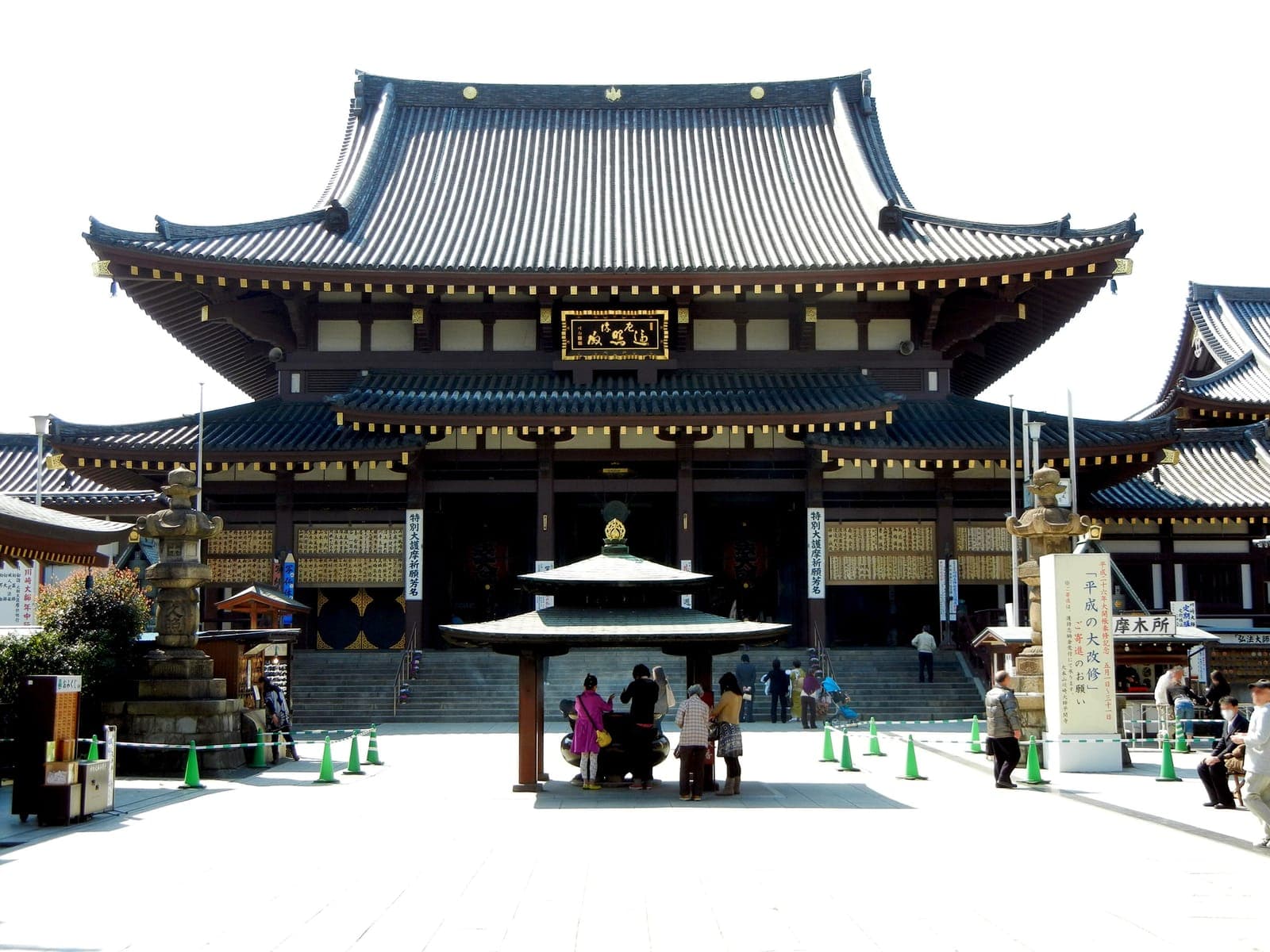
Many temples have a large incense burner called a jōkōro (常香炉). Where incense is offered, obtain the number of sticks indicated and light them at the provided flame. Extinguish the flame by gently fanning with your hand, never by blowing with your mouth. Place the incense in the burner as directed and avoid reaching across other visitors.
Incense is not available at every temple. Some sites restrict it during dry weather, construction, or crowded observances. Never bring your own incense into an area that does not invite it. If smoke is already thick, do not push toward the burner merely to repeat what others are doing.
People may draw smoke toward themselves at some well-known temples. This is a local devotional custom, not a required preparation for Buddhist prayer and not a medical treatment. Leave space for worshippers who are making an offering.
Kawasaki Daishi courtyard. Follow the temple's current signs around incense and worship areas
Pray at the main hall
Stand where worshippers are invited to stop and place a monetary offering in the box if you wish. Ring a bell or strike a gong only when the temple provides one for visitors. Bring your palms together in gasshō (合掌, the prayer gesture) and bow. Then pray quietly.
Do not use the Shinto pattern of two bows, two claps, and one bow at a Buddhist altar. JNTO's official guidance is simple: join your hands in silent prayer, with no clapping. A temple may publish a more specific sequence, and that instruction takes priority.
You do not need to know a sutra or mantra to behave respectfully. If a service is underway, remain at the edge unless visitors are invited to join. Do not imitate chants or ritual gestures for a photograph, and do not imitate priests for one either.
Entering halls, removing shoes, and taking photographs
A threshold, shoe shelf, or raised wooden floor may indicate that shoes must come off, as may a posted sign. Put shoes where directed or use the bag supplied by the temple. Socks are considerate on historic floors. Never step onto tatami or a platform unless the route clearly leads visitors there. The same applies to any inner sanctuary.
Photography permission often changes at the doorway. Exterior photography may be welcome while images of the principal icon, altar, ceremony, or treasure are prohibited. A ticket does not automatically buy photography rights. Check signs again inside each building and silence the shutter where required. Keep tripods out of circulation paths.
At Senso-ji, Todai-ji, or Kiyomizu-dera, the public route is easy to see. At a smaller temple, wait for an invitation rather than opening doors or exploring residential buildings.
Receiving a goshuin after worship
A goshuin (御朱印, a temple or shrine seal) records a visit to a sacred place. Worship first, then look for the goshuinjo or nōkyōjo reception point. Present a dedicated goshuinchō opened to the page you want used, and accept a separate paper version when direct writing is unavailable.
The goshuin collecting guide covers requests and fees as well as paper formats and storage. The important temple-etiquette point is the order: the seal follows the visit and prayer; it is not an admission stamp.
On a numbered pilgrimage, a temple may use a specialized book and sequence. For example, official Shikoku guidance places sutra recitation before the stamp request and distinguishes the pilgrimage nōkyōchō from an ordinary travel notebook.
Leaving the precinct
Return borrowed items and collect shoes without blocking the doorway. Carry rubbish away unless bins are provided. At the gate, step aside and make the local departure bow if appropriate. The gesture should never stop traffic or create a performance around other worshippers.
Respectful temple visiting is less about perfect choreography than attention. Follow the institution in front of you and preserve quiet around worship. Allow religious activity to take precedence over sightseeing.
Frequently asked questions
Do I clap at a Buddhist temple?
Normally, no. Bring your palms together and pray silently. Follow a posted temple instruction if it differs.
Must I burn incense before praying?
No. Offer incense only where the temple provides and permits it. You can still pray respectfully when there is no public burner.
Can non-Buddhists enter and pray?
Many temples welcome visitors of any background. Observe signs and restricted areas. Follow services and staff directions as well.
Should I bow at every temple gate?
A small bow is common in some settings, while pilgrimage routes may document a more formal step. Do not obstruct the gate, and treat local instructions as authoritative.