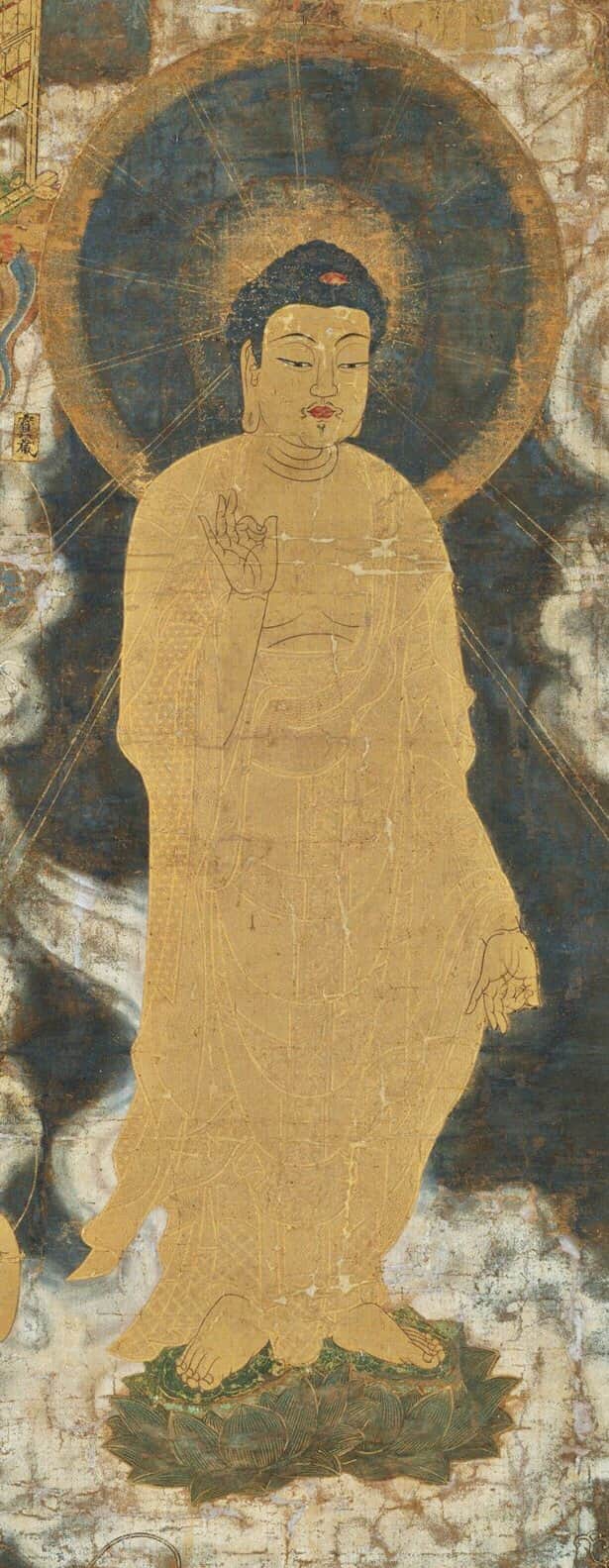
Visit the Ankokuden hall to see the Black Image of Amida Buddha, a statue said to have been worshipped by Ieyasu Tokugawa and credited with protecting him and helping him win battles.
At a Glance
The first thing that catches your eye here is the Sangedatsumon, the great vermilion gate that has watched over this temple since 1622. It is not just an entrance, but a passage into the logic of Jōdo-shū Buddhism, where walking forward is meant to loosen the grip of ordinary concerns. Pass beneath it and, in the traditional understanding, you leave behind the three worldly afflictions of greed, anger, and ignorance. Count the steps and the distances, and the whole approach becomes a meditation in motion: 25 steps recall the 25 Bodhisattvas, 18 steps refer to Amida Buddha’s 18th vow, and the stretch from the Great Gate to the Sanmon Gate measures about 108 ken, echoing the 108 earthly desires from which a person seeks release. This is Zojo-ji, or Zōjō-ji (増上寺), the main temple of Jōdo-shū in Tokyo’s Shiba district, and one of the places where religion, history, and the city’s memory meet most vividly.
Zojo-ji was founded in 1393 as an orthodox nembutsu seminary for Jōdo-shū in the Kantō region. Its origins are tied to the teachings of Hōnen Shōnin, founder of the sect, and to Yūyo Shōsō Shōnin, the 8th patriarch of Jōdo-shū, who is credited in the temple’s own tradition as founder. The temple’s mountain name is San’en-zan, and its main image, or honzon, is Amida Buddha, to whom worshipers recite the nembutsu prayer “Namu Amida Butsu”.
The temple’s fortunes changed dramatically after Tokugawa Ieyasu entered Edo in 1590 to establish his government. In 1598, Zojo-ji was relocated to its present site, where it became the family temple of the Tokugawa and a major institution of the shogunate. During the Edo period, it grew into an immense religious center and an administrative base for Jōdo-shū scholarship and clerical training. At its height, the precincts covered about 826,000 square meters, including 48 subordinate temples and around 150 grammar schools, while as many as 3,000 priests and novices lived and studied there. This was not simply a temple, but a sprawling religious city within the capital.
That grandeur did not survive unchanged. With the end of the Tokugawa order and the start of the Meiji era, anti-Buddhist movements severely affected the temple complex. Later, during World War II, the cathedral, many subsidiary structures, and the Tokugawa mausoleum were burned or destroyed in air raids. What remains today is therefore both historical and reconstructed, a place shaped by loss as much as by continuity.
The oldest surviving building on the grounds is the Sangedatsumon, formally the inner gate. Built in 1622 by the chief carpenter to the shogun, it is one of the oldest wooden structures in Tokyo and an Important Cultural Property. Its design is especially striking. The gate uses an elaborate roofing form, with a hip-and-gable roof rising above a lower pent roof on all four sides of the lower section. This style, introduced from China around the 6th century alongside Buddhism, is paired here with a more restrained Japanese balustrade, creating a blend of imported and local aesthetics. Its bright vermilion lacquer made it one of the most famous landmarks of old Edo.
Inside the second floor, which is closed to the public, are enshrined Shakyamuni Buddha, flanked by two bodhisattvas and 16 arhats, all dating from the Edo period. Notice, too, the absence of the usual fierce Nio guardians. Their omission is meaningful, reflecting Jōdo Buddhism’s emphasis on universal salvation through faith and nembutsu rather than on intimidating gatekeeping.
The great bell, or Daibonshō, is another highlight. Completed in 1673 after casting attempts repeated seven times, it measures 1.76 meters in diameter, 3.33 meters in height, and weighs 15 tons. It is counted among the Three Great Bells of the Edo Period. It is rung twice daily, six times in the early morning and six times in the evening, not only to mark time but to purify the 108 bonnō, the earthly passions that cloud human judgment.
The Kyōzō or sutra repository was originally built in 1613 with financial support from Tokugawa Ieyasu, then substantially remodeled and relocated in 1800. At its center is an octagonal revolving bookshelf, a sophisticated device used to house Buddhist scriptures. Formerly stored here were the three principal canon collections, the Sandaizōkyō, including Sō-ban, Gen-ban, and the Korean Kōrai-ban, all of which were donated by Ieyasu and designated Important Cultural Properties. Today they are kept in a storehouse behind the Kyōzō.
The main hall, known as the Daiden or Hondō, was rebuilt in 1974. It combines traditional temple planning with modern structural design, serving both as the doctrinal heart of the temple and as a flexible space for rites and memorial services. Enshrined there is a large Amida Buddha image from the Muromachi period, with Shan-tao, the Chinese master who refined Pure Land teaching, on the right and Hōnen Shōnin on the left. The hall reflects a living institution, not a museum piece.
Zojo-ji remains the main temple of Jōdo-shū and the central seminary for its priests and novices. Its religious identity is rooted in the Pure Land teaching that salvation is available to anyone who sincerely recites “Namu Amida Butsu.” That openness shaped the temple’s historical role as a place of instruction for a broad public, not only for elites.
The temple’s layout reinforces that theology. The 18 steps leading toward the main hall evoke Amida’s 18th vow, while the 25 steps to the hall recall the 25 Bodhisattvas. The long measured approach through the precincts becomes a physical expression of doctrinal ideas about faith, mercy, and release. Even the bell’s daily ringing participates in this spiritual program, acting as an audible reminder of impermanence and discipline.
Zojo-ji is also deeply intertwined with the Tokugawa shogunate. Six Tokugawa shoguns are buried in the Taitoku-in Mausoleum on the grounds, making the temple a key site for understanding Edo-period political religion. A Treasure Gallery, opened underground in 2015, presents this legacy through Kanō Kazunobu paintings and a model of the mausoleum, giving visitors a clearer sense of what once stood here and why it mattered.
The temple occupies a highly urban but carefully composed landscape in Shiba, with Shiba Park surrounding it and Tokyo Tower rising close beside it. That contrast is part of the experience. The temple grounds offer an unexpectedly calm rhythm within central Tokyo, where trees, broad paved spaces, and the geometry of gates and halls create a feeling of pause amid the city’s density.
The route from outer gate to inner sanctum encourages slow movement. The distances are not incidental. They structure the visitor’s body and attention, turning the approach into a sequence of symbolic thresholds. Even in a modern metropolis, the temple preserves the feeling that one is crossing from ordinary civic space into a disciplined spiritual world.
Today, visitors encounter a temple that is both ancient and rebuilt, ceremonial and urban, quiet and undeniably central to Tokyo’s identity. The Sangedatsumon remains the most important surviving original structure, while the Daiden, Kyōzō, and Treasure Gallery show how the temple has adapted to modern needs without abandoning its doctrinal core. The site continues to host religious rites, memorial services, and educational activity for Jōdo-shū priests and novices.
What makes Zojo-ji unforgettable is the layering. You see the Tokugawa legacy, but also the resilience of a living Buddhist institution. You see a great city temple, but also a place organized by specific vows, numbers, and rituals that are meant to be walked, heard, and remembered. Passing through the gate, hearing the bell, and standing before the main hall, you are not just observing history. You are moving through a carefully designed path of Pure Land Buddhism that has guided people here for more than six centuries.
Painter Kano Kazunobu spent 10 years creating 100 scrolls depicting 500 arhats' daily lives, bathing, studying, floating over hellish scenes, before dying at age 48; his wife directed a student to complete the final four scrolls.
The "Black Image" of Amida Buddha enshrined here is said to have repeatedly saved shogun Ieyasu Tokugawa from danger in battle, earning it a reputation as a victory-bringing deity still worshipped today.
This temple offers 4 different goshuin designs
Special
¥500
Regular
Special
¥1,000
Regular
¥500
Facilities
The main hall has an elevator for easy access. You can also rent wheelchairs, so feel free to ask for one.
Visit the Ankokuden hall to see the Black Image of Amida Buddha, a statue said to have been worshipped by Ieyasu Tokugawa and credited with protecting him and helping him win battles.
Visit the Treasures Gallery in the Daiden basement to see a detailed 1:10 model of the Taitokuin Mausoleum, built for the 1910 Japan-British Exhibition in London and recently returned from the Royal Collection. Open 10am, 4pm daily except Tue; 700
The large bell (Daibonsho) is tolled twice daily at six times each in early morning and evening to purify the 108 earthly passions, so time your visit to hear this 15-ton bell from 1673, one of the Big Three Bells of the Edo Period.
The Sangedatsumon main gate will start a 10-year restoration in April 2025. Visit before then to see the 1622 Important Cultural Property in its current vermilion lacquer, or plan for the work.
Pay a 500 yen entrance fee to enter the Tokugawa Shogun mausoleum area, where six Tokugawa shoguns are buried. See the final resting places of Japan’s most powerful feudal rulers.
The divine spirits venerated at this sacred place
10 structures on the grounds
The temple’s main gate, presented as the Sanmon, is the only surviving original temple building and one of Tokyo’s oldest wooden structures. It is described as an Important Cultural Property and is known for its vermillion exterior.
This sutra storehouse was built in 1613 with financial support from Ieyasu Tokugawa and later remodeled and moved in 1800. The text says it contains revolving bookshelves and has been designated as a cultural property by the Tokyo Metropolitan Government.
This is the temple’s main hall, described as the core of Zojo-ji’s Buddhist structures. It was rebuilt in 1974 and combines traditional Buddhist temple architecture with modern architecture.
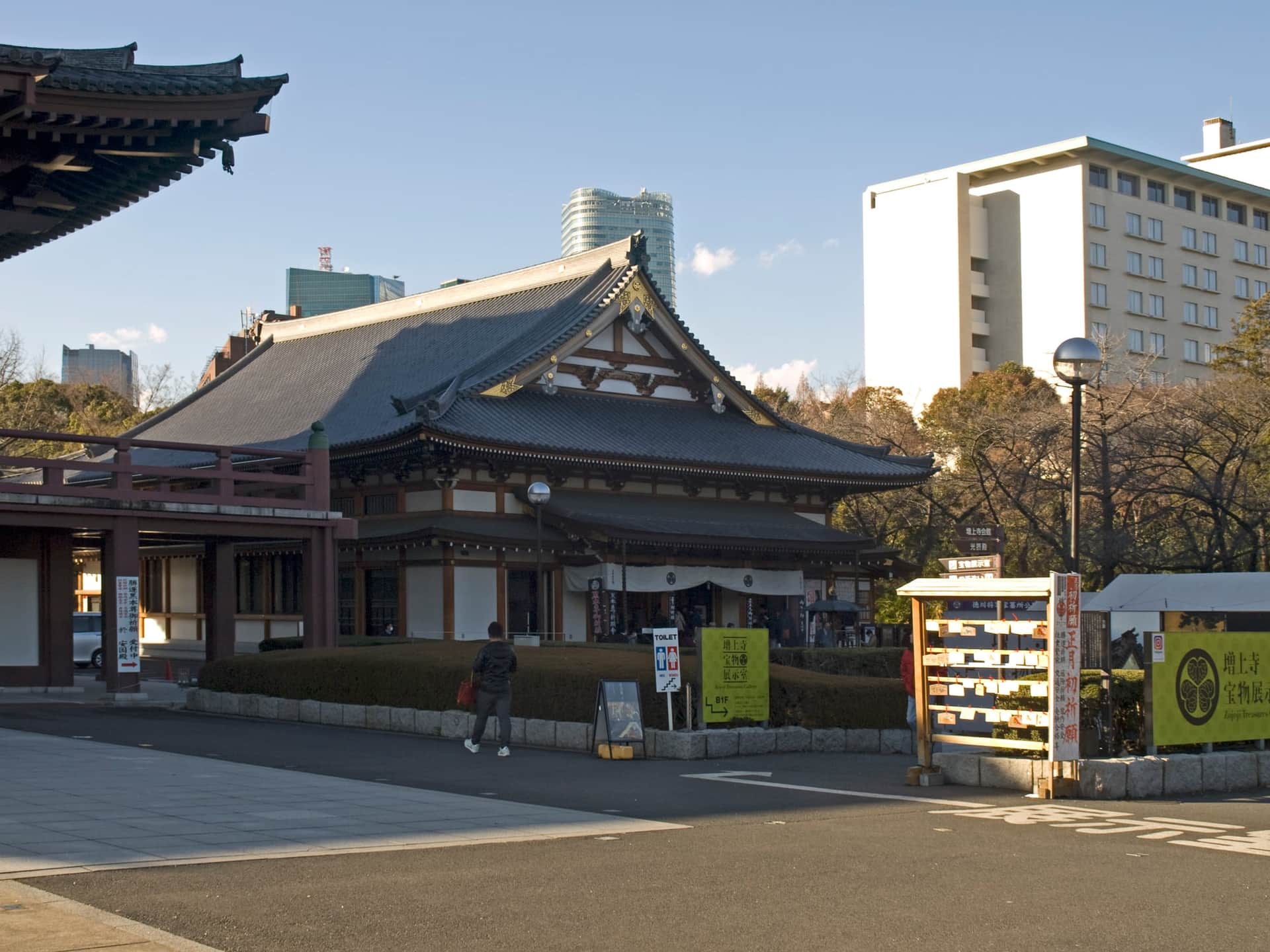
The first basement floor of the Daiden (Great Hall) has the Treasures Gallery, an exhibition space completed in 2015. The gallery’s centerpiece is a highly detailed 1:10 scale model of the Taitokuin Mausoleum, the original burial site of the second shogun, Tokugawa Hidetada (1579–1632). The mausoleum, along with many other Zojoji Temple buildings, was destroyed in the 1945 air raids.
Typical Crowds
Lively
More ways to continue from this place.
Minato, Tokyo Prefecture
What this place is believed to grant
Within 300 m Within 600 m
Timetable data: Public Transportation Open Data Center
Renting needs the operator's app and a Japanese phone number. docomo day passes are sold at convenience stores. Data sources
19 recent posts
4.0
2 reviews
Plan your visit around the Sangedatsumon gate: this 1622 vermilion-lacquered structure begins a 10-year restoration in April 2025, so go before then if you want to see it unscathed. A 500-yen fee covers entry to the shogun mausoleum area, where six Tokugawa shoguns are buried.
Inside the Ankokuden hall, look for the Black Image of Amida Buddha, a statue said to have been worshipped by Ieyasu Tokugawa and credited with protecting him in battle. The Treasures Gallery in the Daiden basement holds a 1:10 model of the Taitokuin Mausoleum, made for the 1910 Japan-British Exhibition and recently returned from the Royal Collection.
 HB
HBHugo Ballesteros checked in
Zojo-ji
Minato, Tokyo