Plan a respectful temple stay in Japan, from choosing a shukubo and understanding meals to joining services and checking current house rules.
GuideDavid Dias9 min read
On this page
Key takeaways
Plan a respectful temple stay in Japan, from choosing a shukubo and understanding meals to joining services and checking current house rules.
A shukubo (宿坊) is lodging operated by a Buddhist temple or a religious community connected to one.
The most useful rule is also the least dramatic: check the individual temple's current information before booking. Rooms and meals differ, as do baths, accessibility, and family policies.
Verify the individual temple
Schedule
Check-in, curfew, meals, and services vary
Facilities
Confirm rooms, baths, stairs, and accessibility
Practice
Ask what is offered and whether booking is required
Source
Prefer the temple or responsible association
Shukubo: How to Plan a Temple Stay in Japan
A shukubo (宿坊) is lodging operated by a Buddhist temple or a religious community connected to one. A stay may include a simple Japanese-style room and vegetarian meals, along with the opportunity to attend a morning service. It is still a stay inside a working religious place, not a themed hotel.
The most useful rule is also the least dramatic: check the individual temple's current information before booking. Rooms and meals differ, as do baths, accessibility, and family policies. Languages supported and religious activities on offer also vary. Even within Koyasan, the official Shukubo Association lists properties separately because each temple has its own arrangements.
This guide explains what the term means and what to verify. It also covers how to take part respectfully without assuming every temple follows one model.
What a shukubo is, and what it is not
Temple lodging grew from the need to accommodate pilgrims and other visitors connected to religious travel. Today some shukubo accept general travelers, but the religious setting remains the point. You are staying where clergy and a temple community keep their own schedule and practices.
That does not mean guests must already understand Buddhism. It means ordinary hotel expectations should not be projected onto the stay. A curfew may protect the temple's routine. A service may begin early. A room may use futons and shared facilities. Photography may stop at the entrance to a sacred space even if photographs are allowed elsewhere.
Koyasan offers the clearest planning model because its official Shukubo Association maintains a directory of lodging temples. Use that directory to identify a property, then read the property's own details. For religious and visitor context, connect the stay with our guide to shrines and temples rather than treating a temple as an unusual hotel category.
How to choose the temple before comparing rooms
Start with what you want to understand or take part in. A pilgrimage stop and a quiet night near a major temple complex are different trips. A stay centered on a specific Buddhist practice is different still.
Ask these questions in order:
Is the lodging operated by the temple named on the booking page?
Which activities are offered on the dates of the stay?
Which activities are open to overnight guests, and which require a separate reservation or fee?
Are participation, meals, baths, or check-in times affected by the temple's schedule?
Does the property meet the guest's dietary, mobility, family, and language needs?
The official Koyasan directory is useful precisely because it links to individual temples. It should not be converted into a promise that all Japanese shukubo provide the same experience. Goshuin Atlas links to Kongobu-ji for Koyasan's institutional context, while current lodging choices should still be checked through the association and each lodging temple.
What to verify before booking
Treat a shukubo reservation like a small research task. A listing platform can show availability, but an official page or direct confirmation is the right source for house rules.
Check
Why it matters
Check-in window and curfew
Temple schedules may be narrower than hotel reception hours
Meal inclusion and serving time
Dinner and breakfast may be served at fixed times
Dietary accommodation
Shojin ryori is not a universal guarantee of every dietary requirement
Room and bathroom arrangement
Futons, shared baths, toilets, and stairs vary by property
Morning service
Time, location, participation rules, and photography restrictions differ
Optional practices
Meditation, sutra copying, or precept ceremonies may require a booking or fee
Children and accessibility
Suitability must be confirmed with the individual property
Cancellation policy
The rule belongs to the property or booking channel, not to shukubo as a category
Koyasan's association says morning services at lodging temples generally begin around 6:00, depending on the temple. That is a Koyasan planning clue, not a nationwide timetable. Its experience page also notes that Ajikan meditation is available at only a few shukubo and should be checked in advance. The same page currently describes a separately timed and paid Jukai precept ceremony. Recheck its official details before relying on a session time or fee.
For a sense of how specific current arrangements can be, the association office lists service from 9:00 to 16:30, while the Jukai page describes a 30-minute ceremony with a ¥1,000 fee. Those figures are operational facts and not part of the definition of shukubo. They must be checked again for the intended date.
Rooms, meals, and shared spaces
Many guests encounter tatami flooring and futons, as well as sliding partitions and shared wash areas. None of those should be promised without a property source. Look for a precise room description and photographs tied to the booked room type.
Meals are often one of the reasons to choose a temple stay. Shojin ryori (精進料理) is cuisine shaped by Buddhist practice and the avoidance of animal products in many temple traditions. A meal described as shojin ryori still needs a direct dietary check. Stock, condiments, and kitchen practices all matter, as do allergies and the temple's own interpretation. "Vegetarian" does not automatically mean vegan or allergy-safe. It may also not be suitable for every religious diet.
Eat at the stated time and follow the host's instructions about where to sit and when to begin. Also follow any instructions about what to do with trays or dishes. The meal is part of the temple's hospitality and discipline, not a food-styling opportunity. Ask before photographing it, especially when other guests or religious spaces would appear in the frame.
Shared spaces reward quiet observation. Remove footwear where directed. Keep luggage out of corridors. Use the provided yukata only where the property permits. Kongobu-ji's official Koyasan guidance says shukubo yukata are indoor wear and should not be worn in main halls or at morning services. They are also not appropriate in Danjo Garan or at Okunoin.
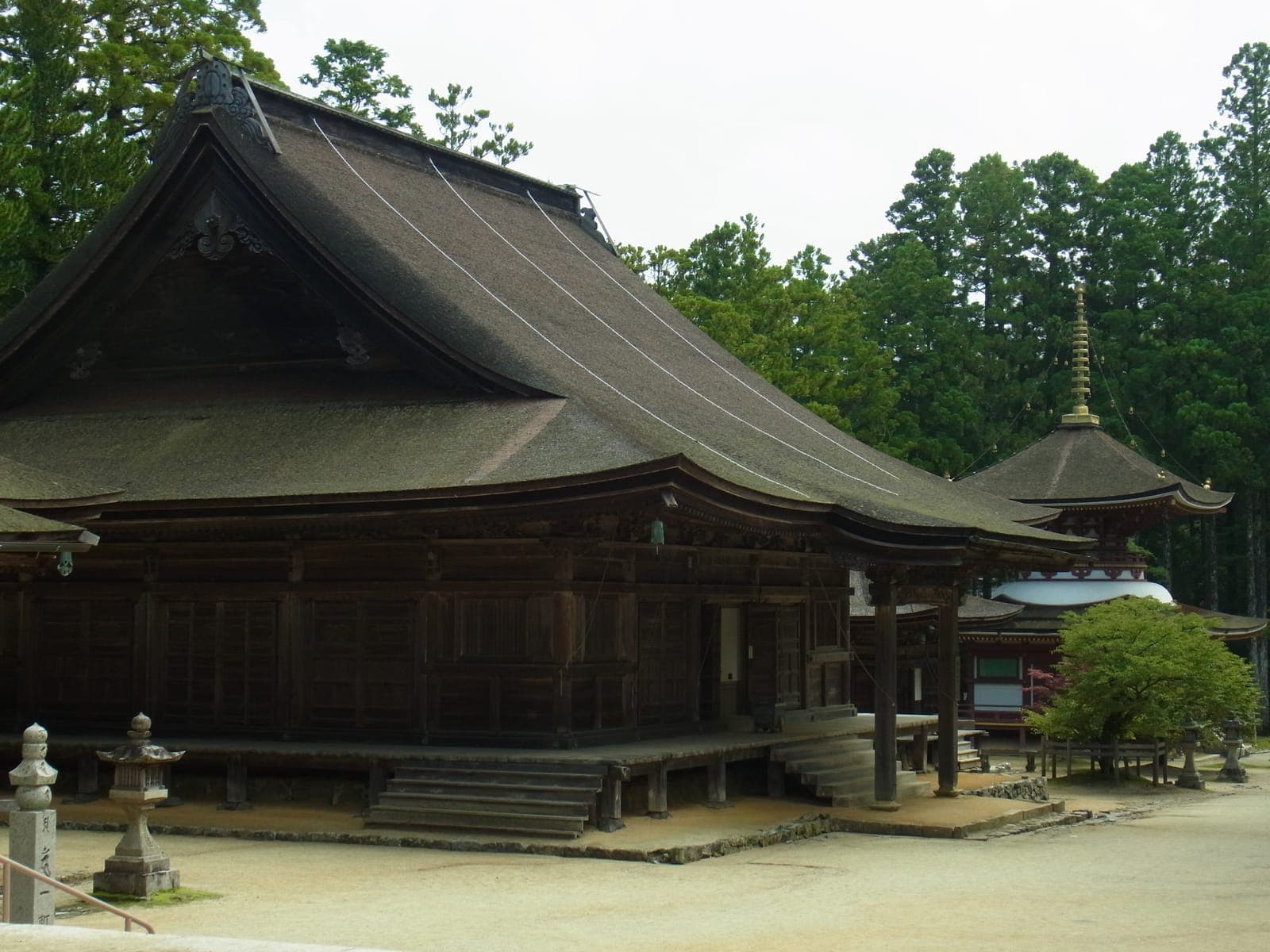
Kongobu-ji, Koyasan. Photo by Nankou Oronain, CC BY-SA 3.0
Morning services and optional practices
An early service can be the most meaningful part of a stay because it places the guest inside the temple's ordinary religious rhythm. It is not a performance staged for visitors.
At Koyasan shukubo, the association says guests may participate in or watch the morning service. Follow the temple's instructions about arrival time and seating. Guidance on clothing, chanting, and movement should also be observed. Kongobu-ji asks visitors to dress formally for services and not wear revealing clothing. “Formal” here is best understood as clean, modest, respectful clothing rather than evening wear.
Do not photograph or record unless permission is explicit. Kongobu-ji prohibits photography in designated areas, and individual temples may set stricter rules. Silence a phone before entering. If the correct physical response is unclear, sit quietly and follow a host rather than copying another guest halfway through a ritual.
Optional practices need the same care. The Koyasan association describes Ajikan meditation and sutra copying, as well as Jukai. Availability is not universal. A practice's name in a travel article is not evidence that a selected temple offers it. If you are interested in copying sutras or Buddhist images, learn the terms shakyo and shabutsu, then confirm the actual program with the temple.
Respectful conduct in a working temple
The best etiquette is attentive rather than theatrical.
Arrive inside the stated check-in window.
Tell the property promptly if travel disruption will make you late.
Wear modest clothing in halls and at services.
Keep voices and devices quiet, especially early and late.
Ask before photographing worship, clergy, other guests, meals, or private interiors.
Follow signs and staff guidance even when it differs from a general travel guide.
Do not enter roped, closed, or private areas.
Treat religious objects as part of worship, not as props.
Kongobu-ji's visitor guidance also gives a Buddhist worship sequence for its halls. Use posted instructions at the place you are visiting, since practices and layouts differ. If you plan to request a goshuin, worship first and use the temple's stated reception location. The complete goshuin guide explains the distinction between worship and collecting.
Danjo Garan, Koyasan. Photo by Nankou Oronain, CC BY-SA 3.0
A booking checklist that prevents surprises
Before payment, save the official property page and confirm the dates to which its details apply. Then record:
property and temple name;
booking channel and cancellation terms;
arrival deadline and curfew;
included meals and dietary confirmation;
room type, stairs, bathroom, and bathing arrangements;
service time and whether attendance is optional;
separately booked practices and fees;
photography and clothing rules;
a direct contact route for delays.
Check the same page again shortly before travel. Operational information can change without altering the basic meaning of shukubo.
Find temple stays without creating false certainty
Goshuin Atlas should only label lodging on a temple record when the temple or its responsible association confirms it. A competitor page or an old review is not enough to add a lodging feature. A mention of Koyasan alone is equally insufficient.
For now, use the official Koyasan shukubo directory for current choices and use Atlas place pages to understand the surrounding religious sites. If a place record shows lodging in the future, look for its source and verification date. That separation keeps a lasting cultural guide useful even when rates and rooms change. Booking policies are subject to the same principle.
Frequently asked questions
Do I need to be Buddhist to stay at a shukubo?
Do not assume a universal rule. Many lodging temples accept general travelers, but eligibility and expectations belong to the individual property. Confirm on its official page.
Is the morning service mandatory?
It varies. Koyasan's association describes participation or observation at its lodging temples, while an individual property may state whether attendance is optional. Check before booking.
Is every shukubo meal vegan?
No universal dietary promise follows from the word shukubo or even from a shojin ryori label. Confirm ingredients and preparation directly. Allergy handling should also be confirmed directly.
Can I wear the provided yukata outside?
Follow the property's rule. Kongobu-ji's Koyasan guidance limits shukubo yukata to indoor use and excludes main halls and services from that permission. Danjo Garan and Okunoin are also excluded.
Can I take photographs during a service?
Only with explicit permission. Treat sacred interiors and services as no-photography areas unless the temple says otherwise.