
Regular
¥500
At a Glance
A single fishing net changed the destiny of Asakusa. On the morning of March 18, 628, two brothers, Hamanari and Takenari Hinokuma, cast their net into the Sumida River, then known as Asakusa Bay. They caught no fish. Instead, the net repeatedly brought up the same small image, a statue of Kannon, the Buddhist figure of compassion. Today, Asakusa Jinja preserves the memory of that discovery and venerates the three men connected with it: the fishermen and Hajinomatsuchi, the learned local landowner who recognized the statue. Known affectionately as Sanja-sama, or “the Three,” the shrine is also the spiritual center of Sanja Matsuri, one of Tokyo’s most famous traditional festivals.
The brothers first carried the mysterious image ashore near present-day Komagata and placed it on the stump of a Japanese pagoda tree, known as an enju. They then asked Hajinomatsuchi to examine it. He identified the figure as Kannon, a powerful object of devotion believed to bring benefits in this world. The brothers embraced faith in the image, prayed intensely, and asked that their next day’s fishing be successful. On March 19, their boat filled with fish.
Hajinomatsuchi soon shaved his head, became a Buddhist monk, transformed his home into a temple, and devoted the remainder of his life to caring for the image and teaching the local population. This episode forms the legendary origin of Sensoji, whose growth brought prosperity to what had once been a small rural settlement.
According to tradition, the descendants of the three men later received a dream revelation from Kannon. The message instructed them to enshrine their ancestors as protective deities beside the Kannon hall. The resulting sanctuary became known as Sanja Gongen, meaning the shrine of the Three Manifestations. Its precise foundation date is unknown. The tradition most plausibly places its establishment between the late Heian period and the early Kamakura period, when the religious idea of gongen was widespread. In that system, a buddha could appear temporarily in the form of a native Japanese kami in order to guide people.
The shrine’s name changed during the modern separation of Buddhist and Shinto institutions. In 1868, the first year of the Meiji era, it became Sanja Myojin Shrine. It was designated a village shrine in 1872, and in 1873 received its present name, Asakusa Jinja, while becoming the general guardian shrine of Asakusa. Local residents still call it Sanja-sama, preserving the older identity.
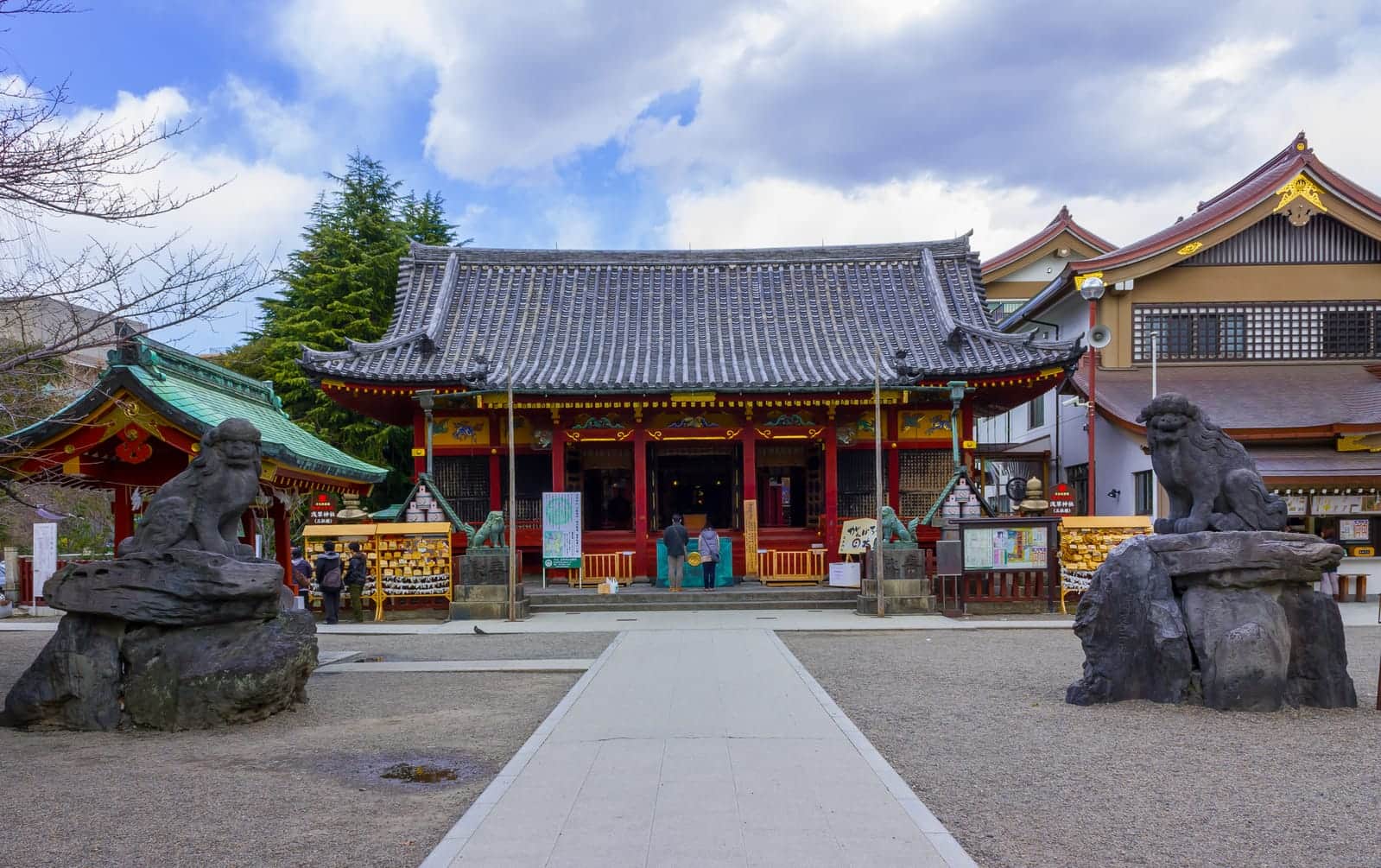
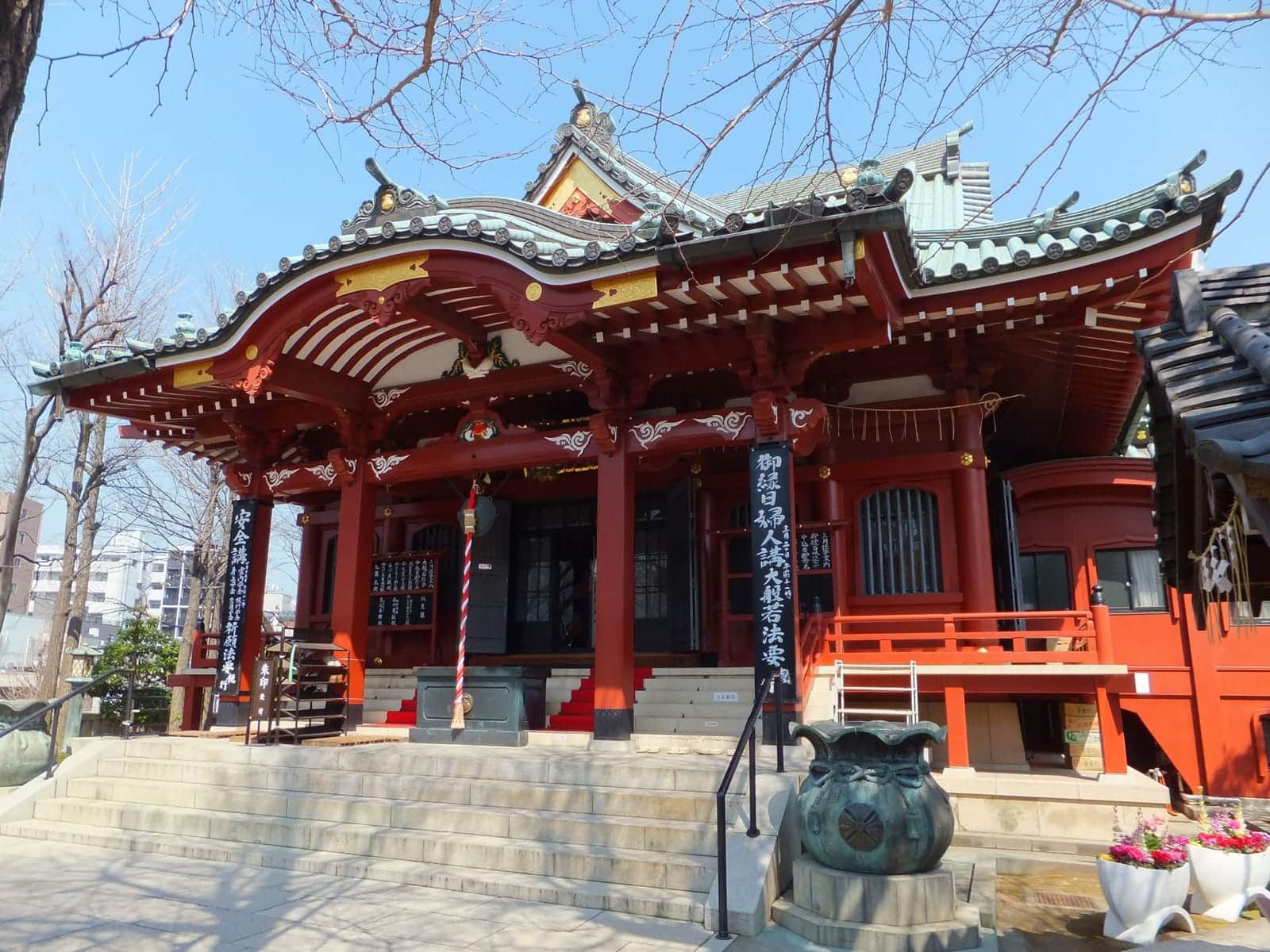
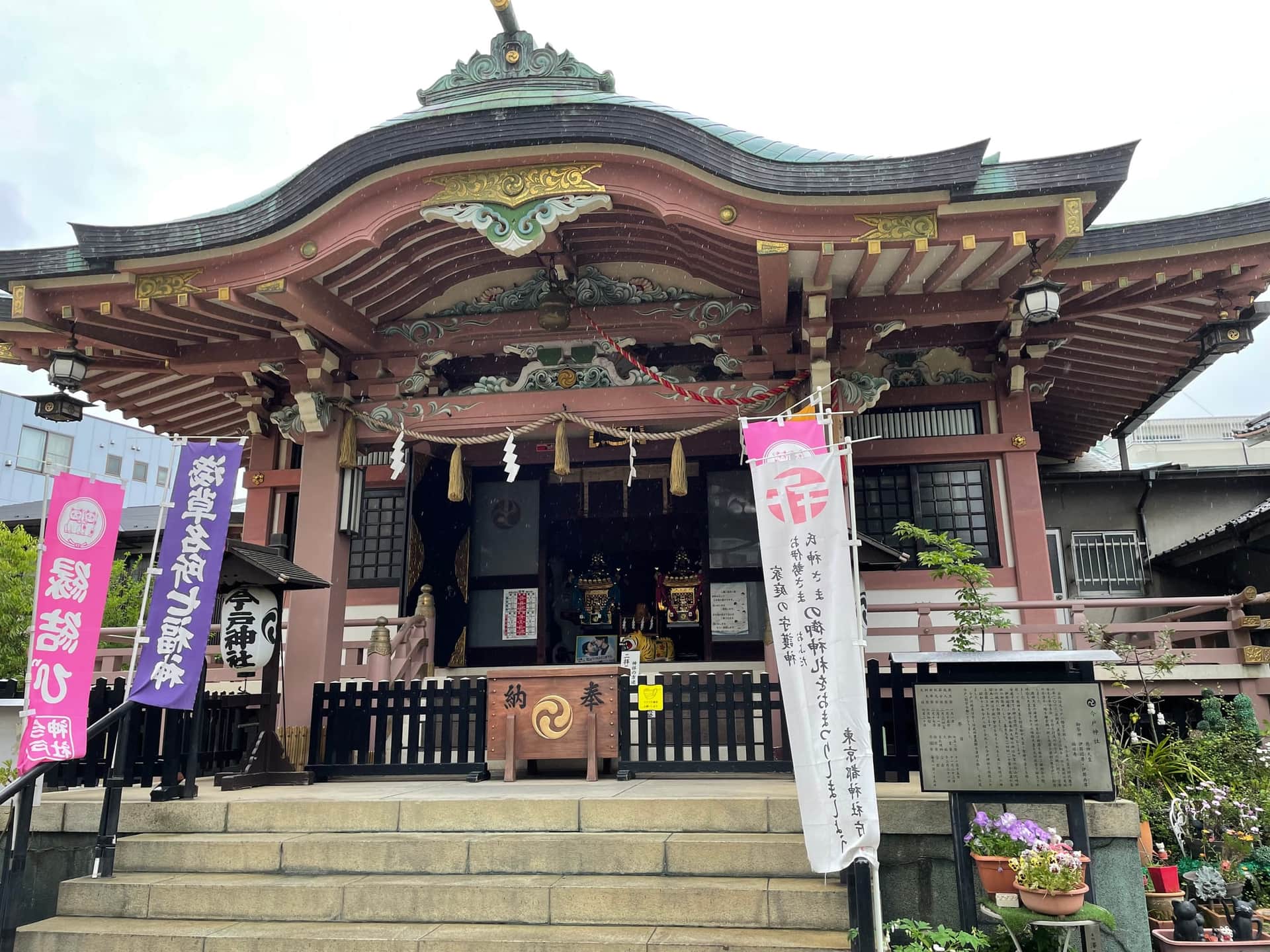
The present buildings were donated and constructed in 1649, during the reign of the third Tokugawa shogun, Tokugawa Iemitsu. Their survival is remarkable. Fires, wartime destruction, and the Great Kanto Earthquake of 1923 damaged much of Tokyo, yet the shrine buildings escaped major loss and retain the appearance of the early Edo period.
The main complex consists of the inner sanctuary, the offering hall, and the worship hall. The latter two are connected by a covered passage, forming the architectural arrangement called gongen-zukuri. This style is associated with important Tokugawa-period sanctuaries, including Nikko Toshogu. It creates a layered progression from the public space of worship toward the more restricted sacred interior.
The buildings were designated an Important Cultural Property of Japan in 1951. By 1996, their painted surfaces and lacquerwork had deteriorated substantially. A restoration costing 350 million yen renewed the exterior decoration. After 33 years had passed since the previous major restoration, the renewed colors brought back the strong reds, greens, golds, and dark lacquer tones characteristic of early Edo architecture.
Look closely at the decorative creatures carved and painted throughout the complex. The phoenix represents auspicious rule and is associated with the birth of a virtuous sovereign. The kirin, a benevolent creature with the body of a deer, the head of a wolf, the tail of an ox, and the feet of a horse, is said to appear when an excellent ruler emerges. The unusual flying dragon, with a fish-like body and wings, governs water. Near the entrance, the right and left ministers, known as imperial retainers, hold weapons whose purpose is to repel evil.
The shrine’s central religious identity comes from the three founders, who are treated as local guardian deities. Their story links the sacred history of Asakusa with the origin of Sensoji and with the community’s prosperity. The relationship also reflects the older, intertwined religious world in which Buddhist and kami traditions worked together before the Meiji government ordered their institutional separation.
The most dramatic expression of this local devotion is Sanja Matsuri, held each year on the third Saturday and Sunday of May. The festival’s present form developed during the Edo period, although its origins are older. The three principal portable shrines, Ichinomiya, Ninomiya, and Sannomiya, are carried through the neighborhood. The procession renews bonds among the shrine’s ujiko, or local parishioners, and expresses prayers for the prosperity of Asakusa. Visitors may see these great mikoshi in the portable shrine storehouse, which opens during the May festival, at New Year, and on some weekends and holidays in early spring.
Other annual observances include sacred dances, miko maiden performances, the traditional Binzasara dance, purification rites, seasonal celebrations, and special worship services. The shrine also conducts ceremonies for newborn children, protection from misfortune, children’s festivals, and Shinto weddings. In modern Asakusa, it supports youth education and the continuation of traditional culture through workshops, seasonal farming activities, harvest events, and community programs.
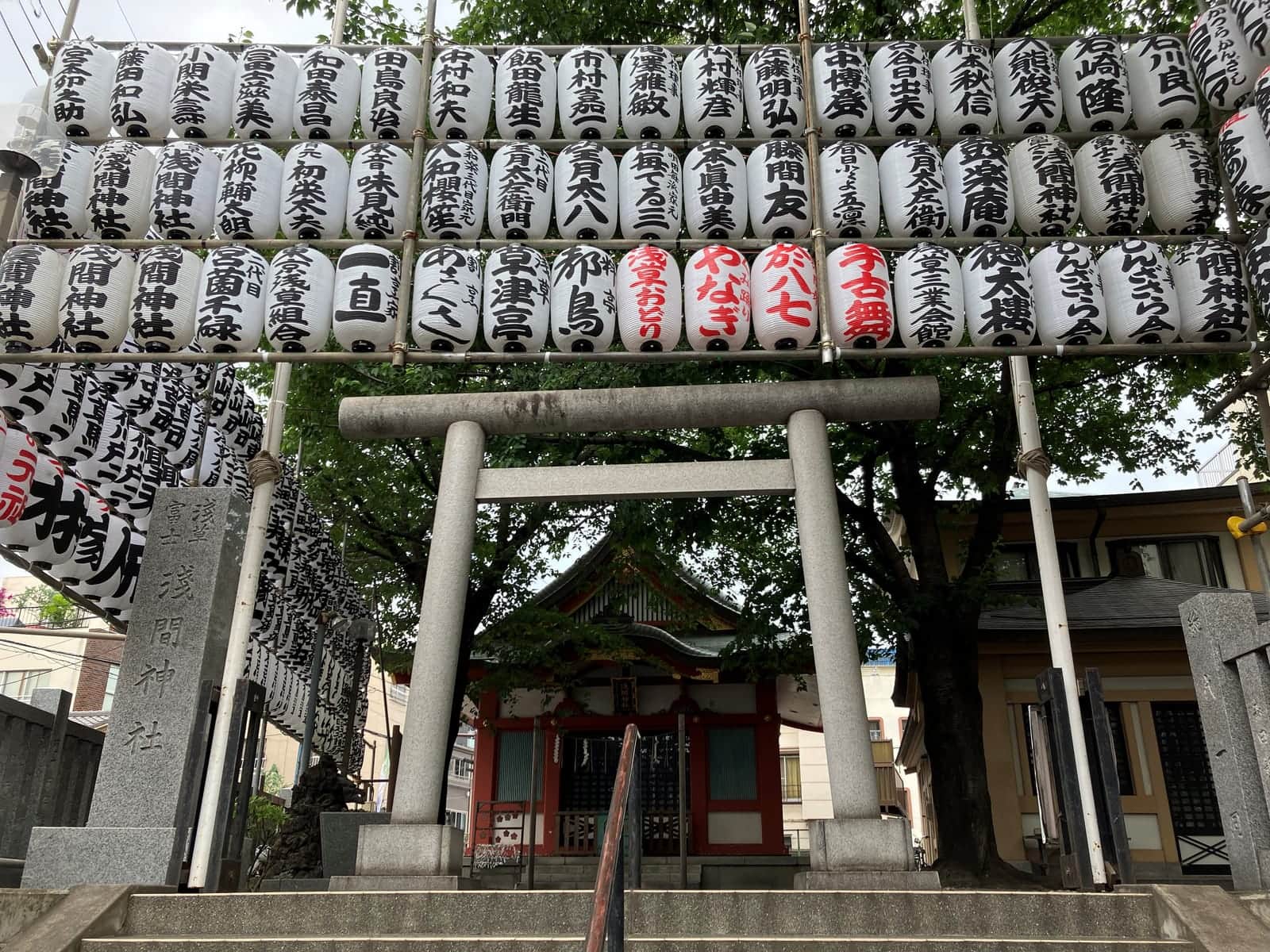
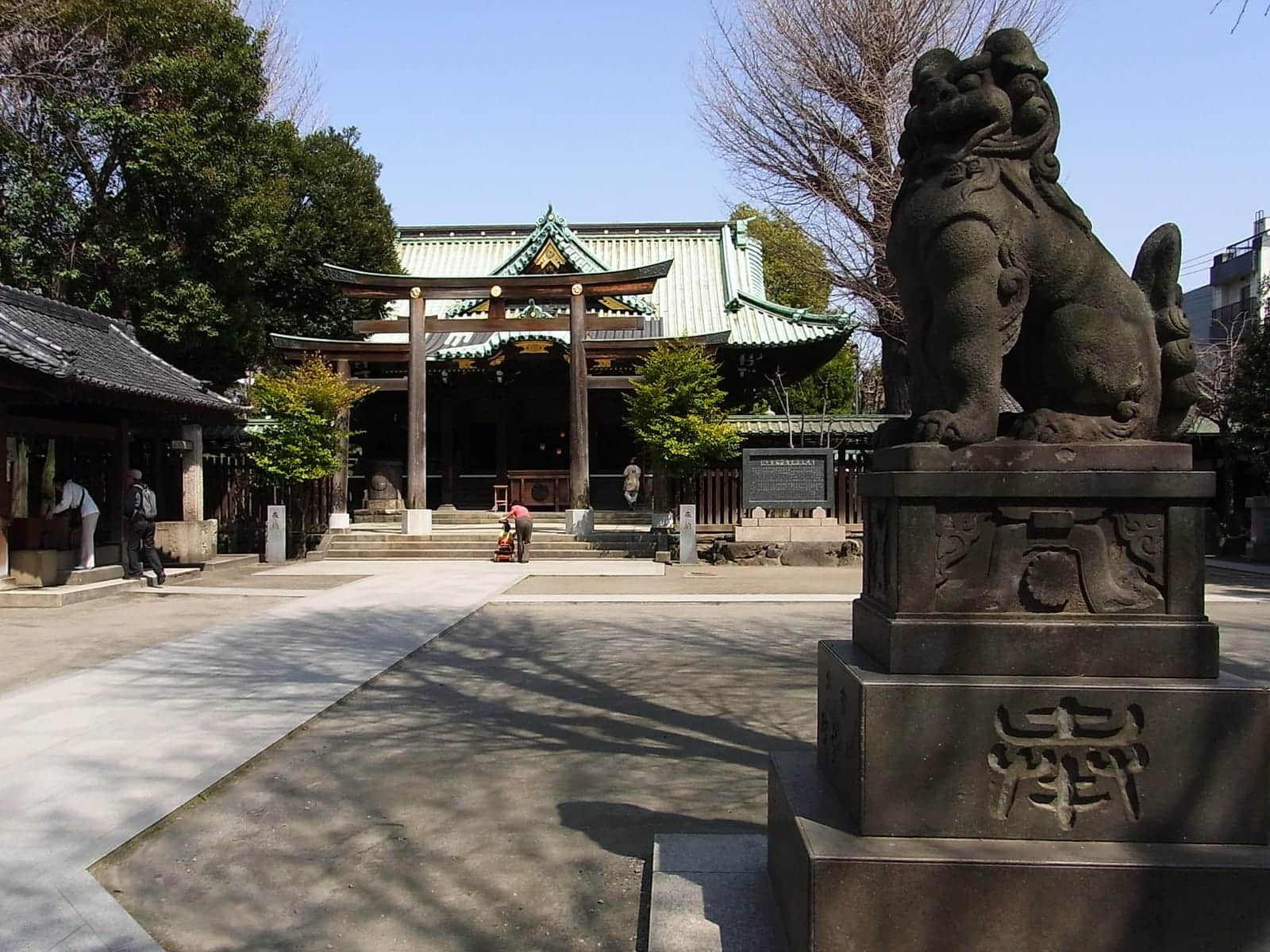
The torii marks the boundary between ordinary human space and the shrine’s sacred precinct. Asakusa Jinja’s front gate is a shinmei torii, erected in September 1885. Beside it is a shrine name tablet written by Sasaki Yukitada, a senior priest associated with the Grand Shrine of Ise.
Before approaching the main building, visitors traditionally use the water purification pavilion to rinse their hands and mouth. The shrine’s sacred tree recalls the founding legend directly. Because the fishermen placed the recovered Kannon image on an enju stump, enju trees growing within the precinct are treated as shinboku, or sacred trees that can serve as vessels for divine presence.
Two especially unusual stone guardian dogs date from the early Edo period. Rather than facing one another separately in the usual manner, these figures appear to sit close together. Their affectionate posture has given them associations with good relationships, marital harmony, and fulfilled love.
The grounds also preserve an extraordinary record of Asakusa’s literary and performing-arts life. Monuments commemorate Kabuki actors, writers, poets, dancers, and local personalities, including Kawatake Mokuami, Nakamura Kichiemon I, Ichikawa En’o I, Kubota Mantaro, and Kawaguchi Matsutaro. Other stones honor the art of flowers, fans, and dance. A monument to the popular manga Kochikame connects the precinct with modern popular culture, while a hyakudo stone marks the route used for repeated devotional visits. The fan monument is connected with an annual ceremony on April 8, when old fans are ceremonially burned.
Asakusa Jinja is located at 2-3-1 Asakusa, Taito-ku, Tokyo. It is approximately seven minutes on foot from Asakusa Station on the Tokyo Metro Ginza Line, Toei Asakusa Line, and Tobu Skytree Line, and about ten minutes from Tsukuba Express Asakusa Station. The shrine adjoins the Sensoji area, but vehicles may enter only from Umamichi-dori. On-site parking is reserved for people receiving prayers and for wedding participants, with permission from shrine staff.
After worship, visitors may receive a goshuin, a calligraphic seal recording the date and place of pilgrimage. The practice originated as proof that a person had deposited a hand-copied sutra at a temple and became common at shrines during the Edo period. At Asakusa Jinja, regular seals include those of Asakusa Jinja, the Asakusa Seven Lucky Gods pilgrimage, and Hikan Inari Shrine, with each regular seal offered for 500 yen. Seasonal seals appear for New Year, Sanja Matsuri, and summer worship. The essential order is simple: bow at the torii, purify yourself, pray with two bows, two claps, and one bow, then request the seal.
The shrine also participates in the Asakusa Seven Lucky Gods circuit, which actually visits nine temples and shrines, and in the Tokyo Fukume-guri, an eight-shrine pilgrimage. These routes extend the experience beyond a single precinct, revealing Asakusa as a living district where sacred tradition, neighborhood memory, performance, and everyday life remain closely connected.
According to legend, two fishermen brothers caught a golden Kannon statue in their net in 628 CE, but kept throwing it back until they realized it was sacred.
A manga character from the long-running series 'Kochira Katsushika-ku Kameari Ekimae Hashutsujo' has his own stone monument inside the shrine grounds.
This shrine offers 6 different goshuin designs
Regular
¥500
Regular
¥500
Regular
¥500
Festival
¥800
Festival
¥800
Regular
If you want to collect a goshuin (stamp), arrive early and be prepared to wait in line, especially during festival periods like Sanja Matsuri in May or seasonal events.
Plan to visit on a weekday or early morning if you're interested in observing the shrine's architecture and spiritual atmosphere without heavy crowds.
Visit during the seasonal special goshuin periods (New Year, Sanja Matsuri in May, summer matsuri, autumn harvest festival, and equinox celebrations) to collect limited-edition stamps featuring intricate cut-paper designs.
If you're driving to the shrine, know that general visitors cannot park on the grounds. Only those receiving prayers (gokito) or attending a wedding can request a parking permit from staff.
Bring your own goshuin book or purchase one at the shrine for 1,000 to 1,500 yen, but note that the shrine will not mail goshuin books or accept pre-made books without purchasing a new stamp.
2 structures on the grounds
1 officially designated assets
Important Cultural Property
Period: 1649頃
Related structure: Outer Worship Hall
Source verified: Sep 8, 2026
Official source · Agency for Cultural Affairs / National Institute of InformaticsSeasonal celebrations and special occasions
Also called Sanja-sama
Taito, Tokyo Prefecture
Typical Crowds
Lively
Visit Duration
45-60 minutes
More ways to continue from this place.
Within 300 m Within 600 m
Timetable data: Public Transportation Open Data Center

OTHER SPACE Asakusa
HELLO CYCLING
トーセイホテル ココネ浅草
HELLO CYCLING

F2-07.台東区民会館・東京都立産業貿易センター台東館
docomo bike share
Renting needs the operator's app and a Japanese phone number. docomo day passes are sold at convenience stores. Data sources
25 recent posts
4.5
4 reviews
Walk past the main Senso-ji hall and turn right. Most visitors turn back at Senso-ji, so this shrine stays noticeably quieter. The grounds are compact, and 15 minutes is enough to see everything.
The main building was constructed by Tokugawa Iemitsu and survives to this day as a designated Important Cultural Property. The carved decorations are detailed and worth a close look. Inside the precinct, rows of lanterns line the worship hall, and a small Inari shrine sits behind the main building.
For the goshuin stamp, wait times are short on ordinary weekdays, but limited seasonal designs draw long queues, so check ahead if that matters to you.
 ДБ
ДБДмитрий Бессонов checked in
Asakusa Jinja
Taito, Tokyo
 JTPro member
Jelle & TimPro shared a goshuin

