Distinguish seasonal goshuin, direct writing, separate-paper kakioki, and decorative formats while checking current official availability.
GuideDavid Dias7 min read
On this page
Key takeaways
Distinguish seasonal goshuin, direct writing, separatepaper kakioki, and decorative formats while checking current official availability.
A seasonal goshuin (御朱印) is a shrine or temple seal whose design or inscription is tied to a limited occasion such as a month, festival, flower, or anniversary.
The reliable source is the issuing shrine or temple. A photograph from last year can show that a design existed, but it cannot prove today's dates or stock.
Seasonal Goshuin and Kakioki: What Changes
A seasonal goshuin (御朱印) is a shrine or temple seal whose design or inscription is tied to a limited occasion such as a month, festival, flower, or anniversary. A kakioki (書き置き) goshuin is prepared on a separate sheet instead of being written directly into your book. Season and format answer different questions, and either can change without notice.
The reliable source is the issuing shrine or temple. A photograph from last year can show that a design existed, but it cannot prove today's dates or stock. It also cannot confirm the current writing method, fee, or reception hours.
Start with the standard goshuin
A regular goshuin normally identifies the sacred place and includes red seals and calligraphy. It also records the visit date. Jinja Honcho connects the practice to older proof of sutra dedication at temples while emphasizing that a shrine goshuin is received after worship.
Special designs do not replace that religious context. They may commemorate a rite or interpret a season, or use a new craft technique, but they remain a record of worship rather than a collectible product detached from the visit.
If this is your first seal, begin with the goshuin collecting guide. It covers prayer and reception language, as well as fees and the dedicated goshuinchō (御朱印帳, seal book).
Direct writing and separate paper
Official pages commonly distinguish jikagaki (直書き, writing directly in the visitor's book) from kakioki (書き置き, a prepared separate sheet). A site may offer both formats, use paper only on busy days, or limit a design to one format.
Kakioki is not a lesser or invalid goshuin. It can reduce queues and allow work to be prepared before a festival. It also supports materials that cannot be brushed into a bound page. Accept the format offered and do not pressure staff to convert a paper design into direct writing.
Ask about format before handing over the book. Useful signs include 直書き for direct writing and 書き置き for a separate sheet. The sign 紙でのお頒かち indicates distribution as paper. The exact spoken reading matters less than showing the notice politely when language is difficult.
Monthly, seasonal, and event-limited designs
A tsukigawari (月替わり, monthly changing) goshuin may draw on flowers or weather, as well as local stories or annual observances. A kikan gentei (期間限定, limited-period) design has stated distribution dates. An event seal may be available only for a festival or ritual day.
Official 2026 listings show why the categories must stay separate. Ohara Shrine publishes monthly and seasonal designs alongside double-page and cut-paper designs. These appear in different combinations of direct writing and kakioki. Sorasaya Inao Shrine lists event seals, some distributed only as prepared paper. The artwork does not tell you the service method. Read the text attached to that exact design.
Dates written in Japanese often use the imperial era. Reiwa 8 (令和8年) is 2026. Check the full start and end date rather than assuming that a flower design lasts for the entire blooming season.
Decorative forms beyond brush and stamp
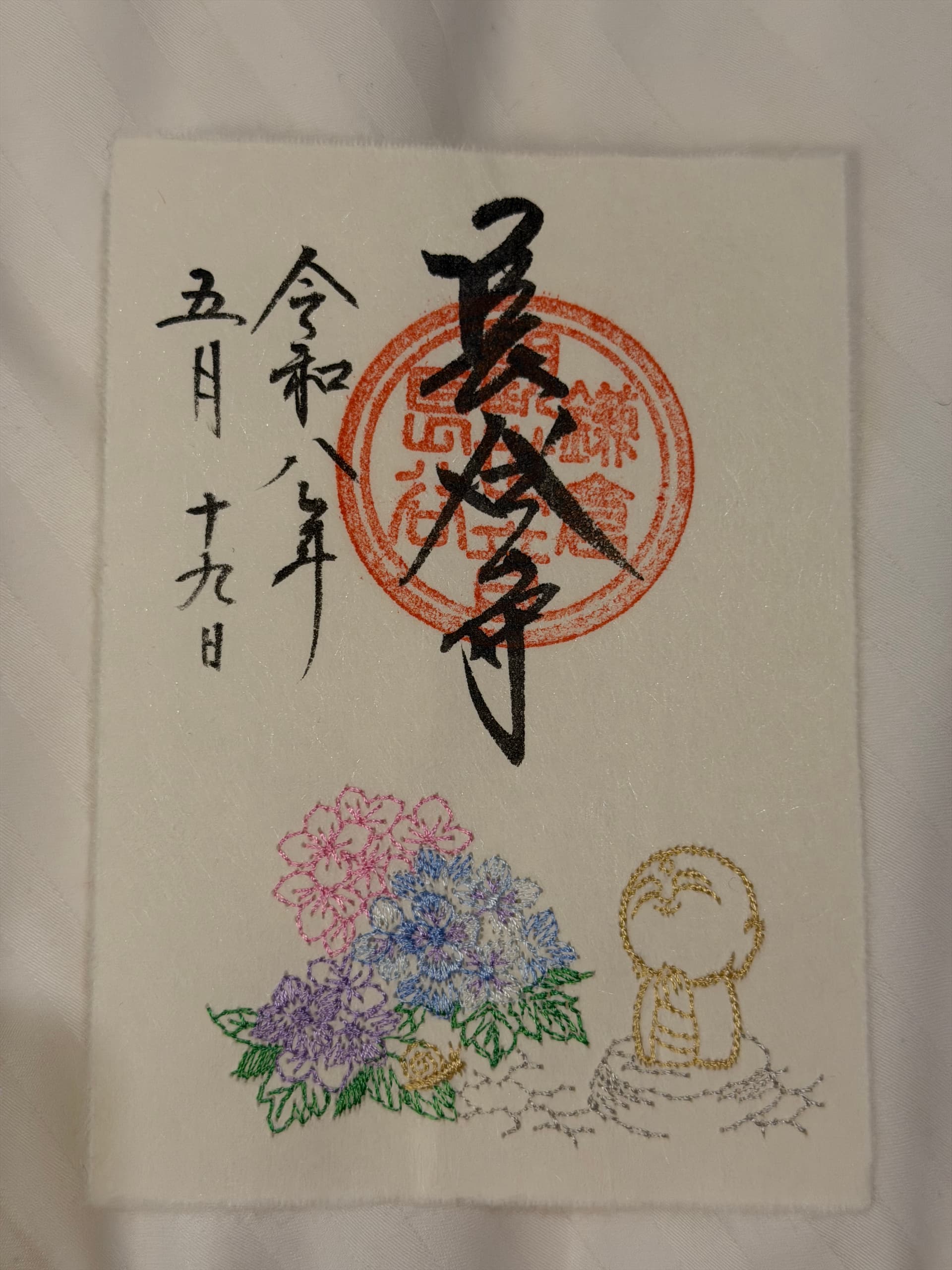
Contemporary official offerings may use kirie (切り絵, cut paper) or embroidery, and some feature transparent material or metallic ink. Layered paper and the mihiraki (見開き, two-page spread) format are also available. These forms can be larger than a standard book page and may need a protective folder.
A decorative goshuin is still issued under the institution's rules. Do not trim a sheet at the reception counter or demand a different color. Do not handle display samples without permission. Some designs are limited in quantity as well as time.
The goshuinchō guide explains page materials and book care. For a large or delicate sheet, measure before attaching it and keep the official paper intact. Goshuin Atlas can preserve a digital image tied to its shrine or temple while the physical page remains stored safely.
Decorative goshuin from Kamakura Hase-dera. Verify the exact design, date, and format with the issuing temple
How to verify a design before visiting
Open the official shrine or temple page. Search the site for 御朱印, 授与品, or a current news post.
Match the exact design. Similar artwork from a previous year may have different dates or conditions.
Check the period and quantity. Look for 期間, 月限定, 当日限定, and 数量限定.
Check direct or paper format. Confirm 直書き, 書き置き, or both.
Check the reception window. Worship hours and goshuin reception hours may differ.
Check current announcements on the day. Ceremonies, staff availability, weather, and queues can change service.
Do not rely on a map review or reseller listing for an operational fact. A reposted image is equally unreliable for current information. Social posts are useful only when they come from the verified official account linked by the institution.
At the reception desk
Worship before joining the goshuin queue. Have the correct book or a folder ready and keep payment simple. Point to the official design name if multiple options are displayed. Staff may limit the number issued per person.
If direct writing is paused, accept kakioki or return another day. A staff absence is not an invitation to leave a book unattended. Tanashi Shrine's official guidance, for example, says that a separate paper version may be used when the priest is unavailable.
Do not ask staff to backdate a goshuin or add an unofficial inscription. Do not ask them to reproduce an expired design. The written date should reflect the institution's practice and your actual visit.
Attaching and recording kakioki
Wait until you have a clean, flat surface. Use a thin, archival-friendly adhesive that will not wrinkle the sheet or seep through the accordion page. Test placement before applying anything, especially with double-page or cut-paper designs.
Record the institution and visit date in Goshuin Atlas, along with the format and any official design name. Photograph both the page and relevant packaging when it carries provenance information. The digital record is a backup and index, not a substitute for worship or evidence that a discontinued design remains available.
Link the record to the correct place, such as Hase-dera in Kamakura, rather than relying on a shared temple name. Duplicate names are common across Japan.
Common mistakes
Treating seasonal and kakioki as synonyms.
Assuming a design is current because an old photo ranks in search results.
Arriving at closing time for a complicated direct-written design.
Asking for direct writing when the notice says paper only.
Buying a supposed goshuin from an unofficial reseller without provenance.
Trimming, laminating, or gluing a delicate sheet before checking its material.
Collecting before worship or blocking the reception display for photographs.
The fastest verification path is the official notice for the exact design. Everything else is a lead that still needs confirmation.
Frequently asked questions
Is kakioki a real goshuin?
Yes. It is a goshuin distributed on a separate prepared sheet. The issuing shrine or temple determines the format.
Are seasonal goshuin always more expensive?
No. Fees vary by institution and design, and may also differ by material or year. Check the current official listing rather than applying a national range.
Can I request last month's design?
Only if the institution explicitly continues it. Do not ask staff to recreate an expired or sold-out seal.
Should I glue a kakioki into my book immediately?
Not necessarily. Protect it flat until you can check the size and orientation as well as the material, then attach it carefully or store it separately.