
Régulier
¥500
En bref
A single fishing net changed the destiny of Asakusa. On the morning of March 18, 628, two brothers, Hamanari and Takenari Hinokuma, cast their net into the Sumida River, then known as Asakusa Bay. They caught no fish. Instead, the net repeatedly brought up the same small image, a statue of Kannon, the Buddhist figure of compassion. Today, Asakusa Jinja preserves the memory of that discovery and venerates the three men connected with it: the fishermen and Hajinomatsuchi, the learned local landowner who recognized the statue. Known affectionately as Sanja-sama, or “the Three,” the shrine is also the spiritual center of Sanja Matsuri, one of Tokyo’s most famous traditional festivals.
The brothers first carried the mysterious image ashore near present-day Komagata and placed it on the stump of a Japanese pagoda tree, known as an enju. They then asked Hajinomatsuchi to examine it. He identified the figure as Kannon, a powerful object of devotion believed to bring benefits in this world. The brothers embraced faith in the image, prayed intensely, and asked that their next day’s fishing be successful. On March 19, their boat filled with fish.
Hajinomatsuchi soon shaved his head, became a Buddhist monk, transformed his home into a temple, and devoted the remainder of his life to caring for the image and teaching the local population. This episode forms the legendary origin of Sensoji, whose growth brought prosperity to what had once been a small rural settlement.
According to tradition, the descendants of the three men later received a dream revelation from Kannon. The message instructed them to enshrine their ancestors as protective deities beside the Kannon hall. The resulting sanctuary became known as Sanja Gongen, meaning the shrine of the Three Manifestations. Its precise foundation date is unknown. The tradition most plausibly places its establishment between the late Heian period and the early Kamakura period, when the religious idea of gongen was widespread. In that system, a buddha could appear temporarily in the form of a native Japanese kami in order to guide people.
The shrine’s name changed during the modern separation of Buddhist and Shinto institutions. In 1868, the first year of the Meiji era, it became Sanja Myojin Shrine. It was designated a village shrine in 1872, and in 1873 received its present name, Asakusa Jinja, while becoming the general guardian shrine of Asakusa. Local residents still call it Sanja-sama, preserving the older identity.
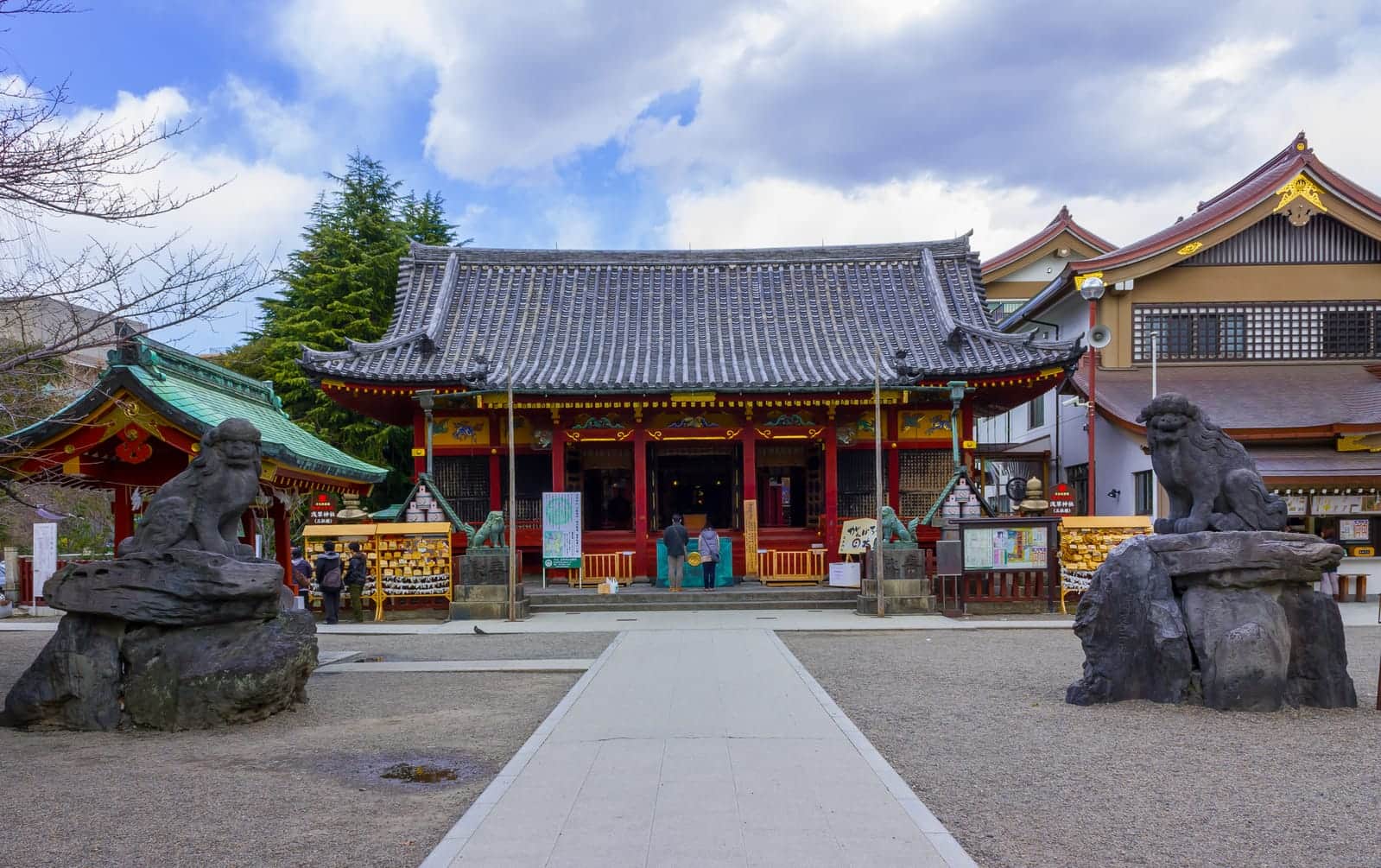
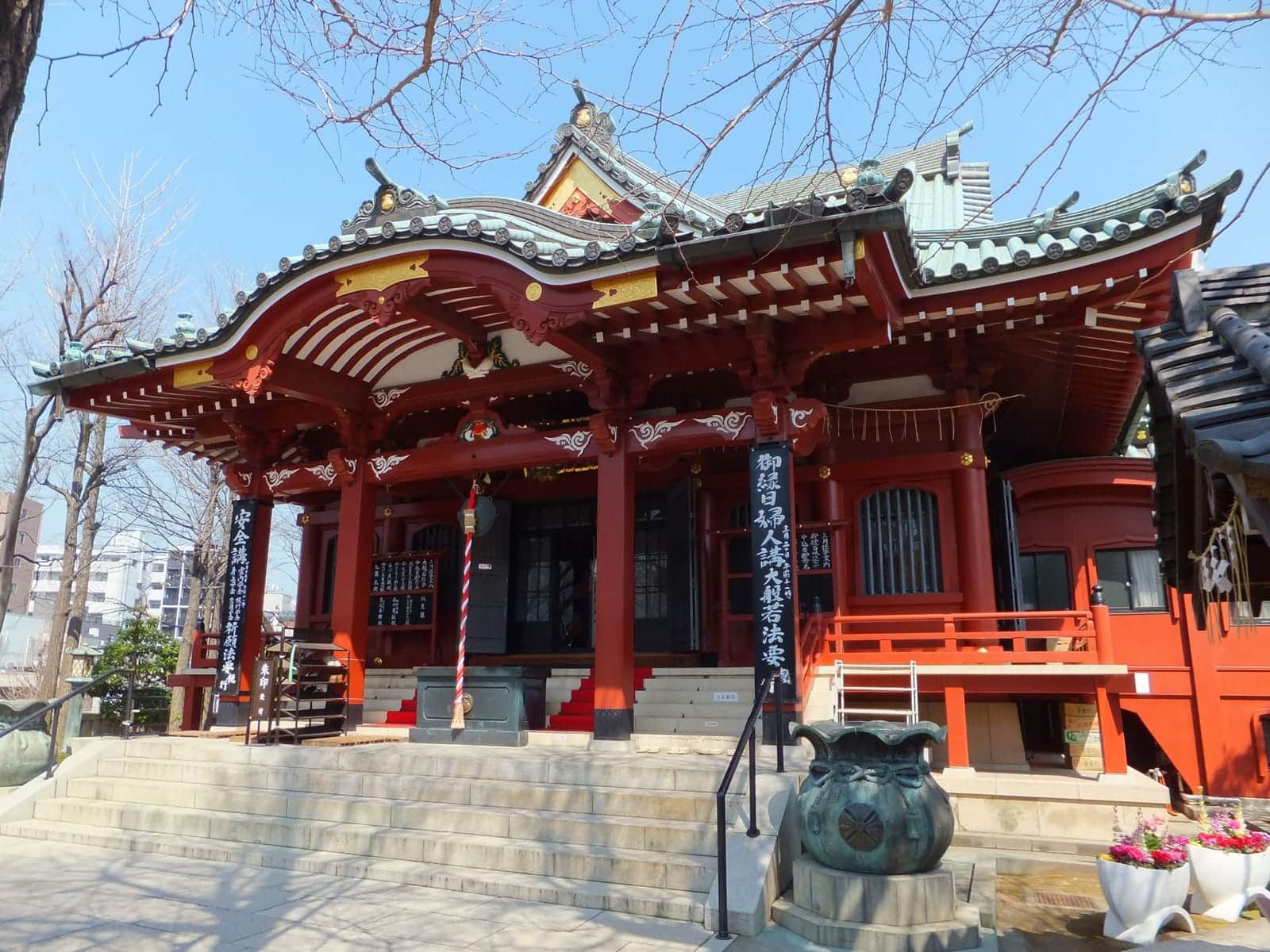
The present buildings were donated and constructed in 1649, during the reign of the third Tokugawa shogun, Tokugawa Iemitsu. Their survival is remarkable. Fires, wartime destruction, and the Great Kanto Earthquake of 1923 damaged much of Tokyo, yet the shrine buildings escaped major loss and retain the appearance of the early Edo period.
The main complex consists of the inner sanctuary, the offering hall, and the worship hall. The latter two are connected by a covered passage, forming the architectural arrangement called gongen-zukuri. This style is associated with important Tokugawa-period sanctuaries, including Nikko Toshogu. It creates a layered progression from the public space of worship toward the more restricted sacred interior.
The buildings were designated an Important Cultural Property of Japan in 1951. By 1996, their painted surfaces and lacquerwork had deteriorated substantially. A restoration costing 350 million yen renewed the exterior decoration. After 33 years had passed since the previous major restoration, the renewed colors brought back the strong reds, greens, golds, and dark lacquer tones characteristic of early Edo architecture.
Look closely at the decorative creatures carved and painted throughout the complex. The phoenix represents auspicious rule and is associated with the birth of a virtuous sovereign. The kirin, a benevolent creature with the body of a deer, the head of a wolf, the tail of an ox, and the feet of a horse, is said to appear when an excellent ruler emerges. The unusual flying dragon, with a fish-like body and wings, governs water. Near the entrance, the right and left ministers, known as imperial retainers, hold weapons whose purpose is to repel evil.
The shrine’s central religious identity comes from the three founders, who are treated as local guardian deities. Their story links the sacred history of Asakusa with the origin of Sensoji and with the community’s prosperity. The relationship also reflects the older, intertwined religious world in which Buddhist and kami traditions worked together before the Meiji government ordered their institutional separation.
The most dramatic expression of this local devotion is Sanja Matsuri, held each year on the third Saturday and Sunday of May. The festival’s present form developed during the Edo period, although its origins are older. The three principal portable shrines, Ichinomiya, Ninomiya, and Sannomiya, are carried through the neighborhood. The procession renews bonds among the shrine’s ujiko, or local parishioners, and expresses prayers for the prosperity of Asakusa. Visitors may see these great mikoshi in the portable shrine storehouse, which opens during the May festival, at New Year, and on some weekends and holidays in early spring.
Other annual observances include sacred dances, miko maiden performances, the traditional Binzasara dance, purification rites, seasonal celebrations, and special worship services. The shrine also conducts ceremonies for newborn children, protection from misfortune, children’s festivals, and Shinto weddings. In modern Asakusa, it supports youth education and the continuation of traditional culture through workshops, seasonal farming activities, harvest events, and community programs.
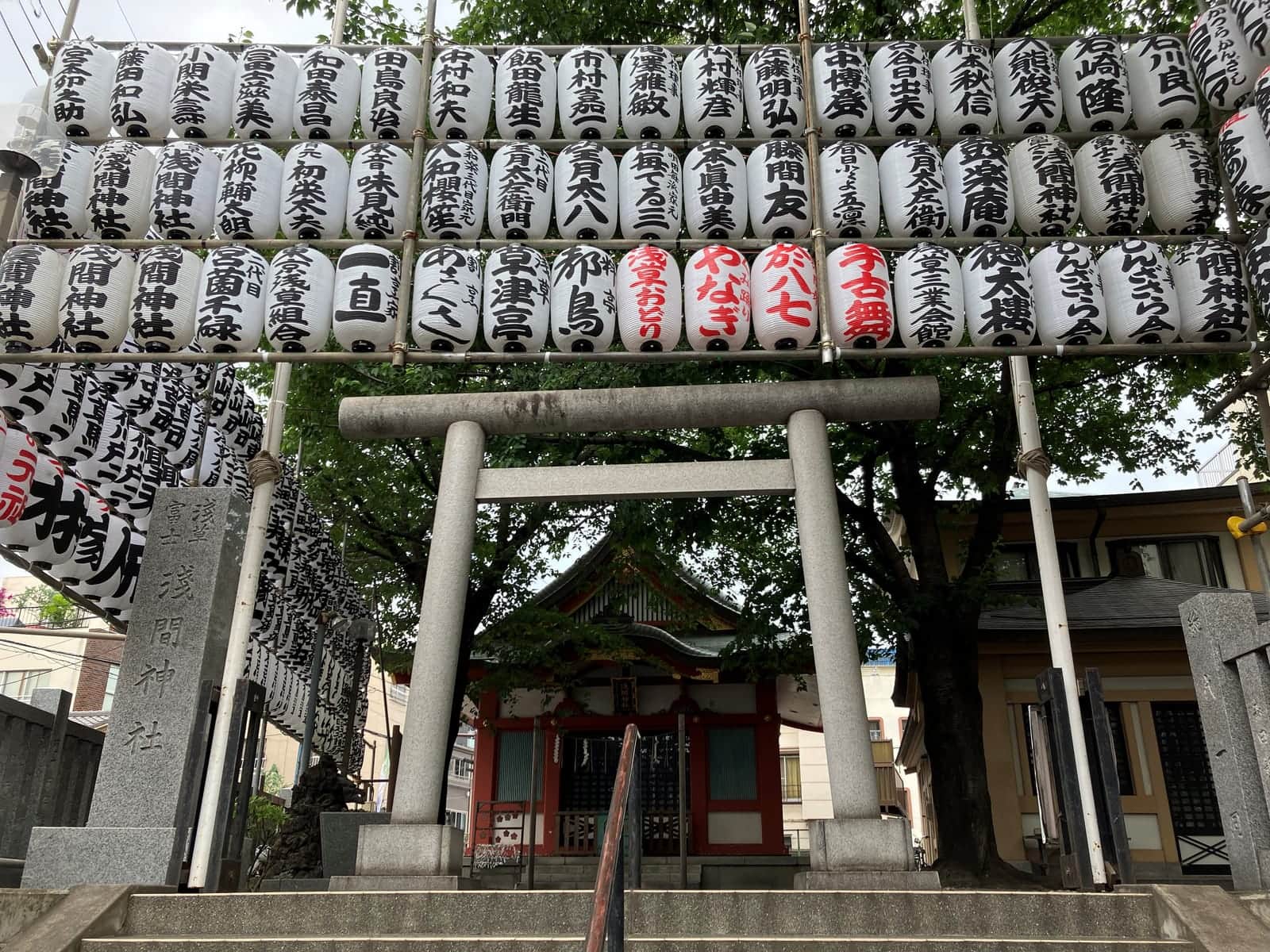
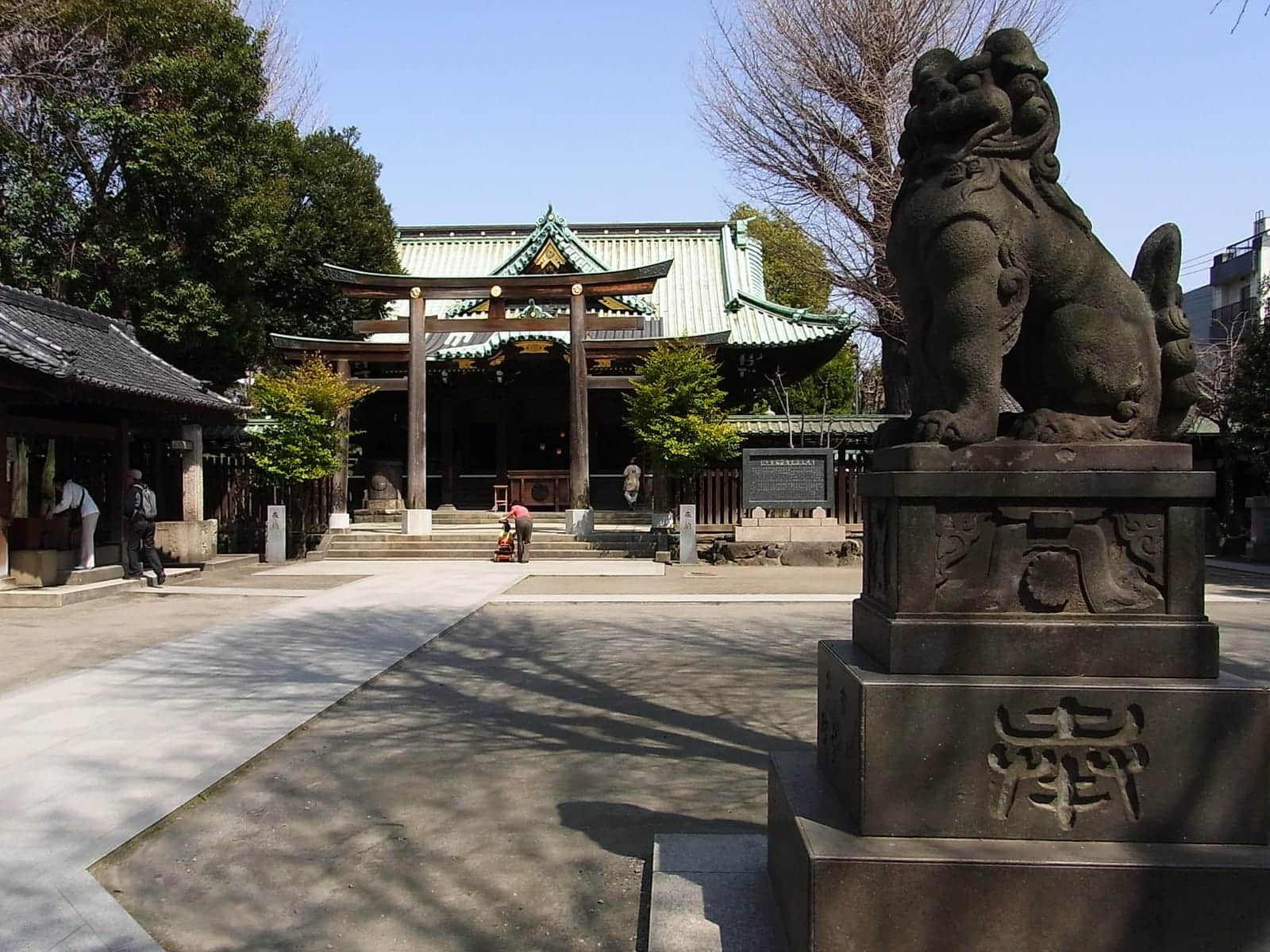
The torii marks the boundary between ordinary human space and the shrine’s sacred precinct. Asakusa Jinja’s front gate is a shinmei torii, erected in September 1885. Beside it is a shrine name tablet written by Sasaki Yukitada, a senior priest associated with the Grand Shrine of Ise.
Before approaching the main building, visitors traditionally use the water purification pavilion to rinse their hands and mouth. The shrine’s sacred tree recalls the founding legend directly. Because the fishermen placed the recovered Kannon image on an enju stump, enju trees growing within the precinct are treated as shinboku, or sacred trees that can serve as vessels for divine presence.
Two especially unusual stone guardian dogs date from the early Edo period. Rather than facing one another separately in the usual manner, these figures appear to sit close together. Their affectionate posture has given them associations with good relationships, marital harmony, and fulfilled love.
The grounds also preserve an extraordinary record of Asakusa’s literary and performing-arts life. Monuments commemorate Kabuki actors, writers, poets, dancers, and local personalities, including Kawatake Mokuami, Nakamura Kichiemon I, Ichikawa En’o I, Kubota Mantaro, and Kawaguchi Matsutaro. Other stones honor the art of flowers, fans, and dance. A monument to the popular manga Kochikame connects the precinct with modern popular culture, while a hyakudo stone marks the route used for repeated devotional visits. The fan monument is connected with an annual ceremony on April 8, when old fans are ceremonially burned.
Asakusa Jinja is located at 2-3-1 Asakusa, Taito-ku, Tokyo. It is approximately seven minutes on foot from Asakusa Station on the Tokyo Metro Ginza Line, Toei Asakusa Line, and Tobu Skytree Line, and about ten minutes from Tsukuba Express Asakusa Station. The shrine adjoins the Sensoji area, but vehicles may enter only from Umamichi-dori. On-site parking is reserved for people receiving prayers and for wedding participants, with permission from shrine staff.
After worship, visitors may receive a goshuin, a calligraphic seal recording the date and place of pilgrimage. The practice originated as proof that a person had deposited a hand-copied sutra at a temple and became common at shrines during the Edo period. At Asakusa Jinja, regular seals include those of Asakusa Jinja, the Asakusa Seven Lucky Gods pilgrimage, and Hikan Inari Shrine, with each regular seal offered for 500 yen. Seasonal seals appear for New Year, Sanja Matsuri, and summer worship. The essential order is simple: bow at the torii, purify yourself, pray with two bows, two claps, and one bow, then request the seal.
The shrine also participates in the Asakusa Seven Lucky Gods circuit, which actually visits nine temples and shrines, and in the Tokyo Fukume-guri, an eight-shrine pilgrimage. These routes extend the experience beyond a single precinct, revealing Asakusa as a living district where sacred tradition, neighborhood memory, performance, and everyday life remain closely connected.
Le hall principal du sanctuaire a été construit en 1649 par le troisième shogun Tokugawa et a survécu à 350 ans d'incendies, de guerres et au tremblement de terre de 1923 sans dommages majeurs.
La paire de chiens-lions (komainu) du sanctuaire date du début de la période Edo et est d'une valeur exceptionnelle pour sa forme rare, censée apporter de bonnes relations et de la chance en mariage.
Ce sanctuaire offre 6 designs de goshuin différents
Régulier
¥500
Régulier
¥500
Régulier
¥500
Festival
¥800
Festival
¥800
Régulier
Si vous souhaitez collecter un goshuin (sceau), arrivez tôt et préparez-vous à faire la queue, en particulier pendant les périodes de festival comme le Sanja Matsuri en mai ou les événements saisonniers.
Prévoyez de visiter en semaine ou tôt le matin si vous souhaitez observer l'architecture du sanctuaire et son atmosphère spirituelle sans foules importantes.
Visitez pendant les périodes spéciales de goshuin saisonnières (Nouvel An, Sanja Matsuri en mai, matsuri d'été, festival de récolte d'automne et célébrations des équinoxes) pour collecter des timbres en édition limitée présentant des motifs complexes en papier découpé.
Si vous vous rendez au sanctuaire en voiture, sachez que les visiteurs ordinaires ne peuvent pas se garer sur le terrain. Seules les personnes recevant des prières (gokito) ou assistant à un mariage peuvent demander un permis de stationnement auprès du personnel.
Apportez votre propre carnet de goshuin ou achetez-en un au sanctuaire pour 1 000 à 1 500 yens, mais notez que le sanctuaire n'enverra pas de carnets de goshuin par la poste et n'acceptera pas les carnets pré-faits sans acheter un nouveau timbre.
2 structures sur le site
1 biens officiellement désignés
Bien culturel important
Période: 1649頃
Structure associée: Outer Worship Hall
Source vérifiée: 8 sept. 2026
Source officielle · Agency for Cultural Affairs / National Institute of InformaticsCélébrations saisonnières et occasions spéciales
Affluence typique
Vivant
Durée de visite
45-60 minutes
Autres pages utiles liées à ce lieu.
Aussi connu sous le nom de Sanja-sama
Taito, Tokyo Préfecture
Moins de 300 m Moins de 600 m
Données horaires : Public Transportation Open Data Center

OTHER SPACE Asakusa
HELLO CYCLING
トーセイホテル ココネ浅草
HELLO CYCLING

F2-07.台東区民会館・東京都立産業貿易センター台東館
docomo bike share
La location nécessite l'application de l'opérateur et un numéro de téléphone japonais. Les pass journée docomo sont vendus dans les supérettes. Sources de données
38 publications récentes
4.7
7 avis
Passez devant le bâtiment principal du Senso-ji et tournez à droite. La plupart des visiteurs font demi-tour au Senso-ji, ce sanctuaire reste donc nettement plus calme. Le domaine est compact et 15 minutes suffisent pour tout voir.
Le bâtiment principal a été construit par Tokugawa Iemitsu et subsiste encore aujourd'hui en tant que Bien culturel important désigné. Les décorations sculptées sont détaillées et méritent un examen attentif. À l'intérieur de l'enceinte, des rangées de lanternes bordent la salle de culte, et un petit sanctuaire Inari se trouve derrière le bâtiment principal.
Pour le tampon goshuin, les temps d'attente sont courts les jours de semaine ordinaires, mais les designs saisonniers limités attirent de longues files d'attente, alors renseignez-vous à l'avance si cela vous importe.
 VW
VWValerie Wadsworth a laissé un avis
Alexandre Feutren s’est enregistré
Asakusa Jinja
Taito, Tokyo

