Temple
Taisan-ji
Imabari•2.1km(26 min walk)
At a Glance
The principal image here has survived fire after fire, and the monks who tended it gave it a name that tells the whole story: Hifuse Fudoson, the Fire Fighting Immovable Wisdom King. That a statue could outlast repeated catastrophes across more than a thousand years says something about the tenacity of this place, and about the people who kept rebuilding it.
Enmei-ji is the 54th temple on the Shikoku 88 Temple Pilgrimage, sitting at the foot of Mt. Chikamiyama, a 244-meter peak roughly six kilometers northwest of downtown Imabari in Ehime Prefecture. The mountain's modest height belies the scale of what once stood here: according to tradition, the original complex included seven major temple buildings and 100 monks' cells spread across the valley. What you see today is quieter, more intimate, but the weight of that long history is present in every stone.
The founding story reaches back to 720 CE, when the monk Gyoki is said to have carved a statue of Fudo Myoo at the order of Emperor Shomu (who reigned 724 to 749). That statue was understood to be an incarnation of Dainichi Nyorai, the cosmic Buddha at the center of Shingon cosmology, and it became the temple's principal image. A century later, during the Konin era (810 to 824), the great monk Kobo Daishi received an imperial commission from Emperor Saga to rebuild and expand the complex as a center of both religion and learning. The temple was renamed Fudoin Enmeiji and elevated to the status of an imperial temple, a designation that placed it among the most prestigious religious institutions in the land.
The name carried a subtle complication. Written with the characters 圓明寺, it was easily confused with Temple 53, another site called Enmyoji with identical kanji, located not far away on the same pilgrimage circuit. The confusion persisted for centuries until, drawing on an alternate name the temple had used since the Edo period (1603 to 1868), the characters were officially changed to 延命寺 after the Meiji Restoration in the latter half of the 19th century. The pronunciation shifted slightly, the meaning shifted too ("延命" carries the sense of prolonging life), but the continuity of the place itself never broke.
One of the most intellectually significant moments in the temple's history came in 1268, when Gyonen (1240 to 1321), a monk of the Kegon sect, stayed at the monastery and wrote the Hasshu Koyo, a two-volume introductory text covering the eight schools of Buddhism: Kusha, Jojitsu, Ritsu, Hosso, Sanron, Tendai, Kegon, and the newly emerged Jodo. The work became a foundational primer for Buddhist beginners, and the fact that it was composed here, in this valley monastery, speaks to the scholarly reputation the temple held during the medieval period.
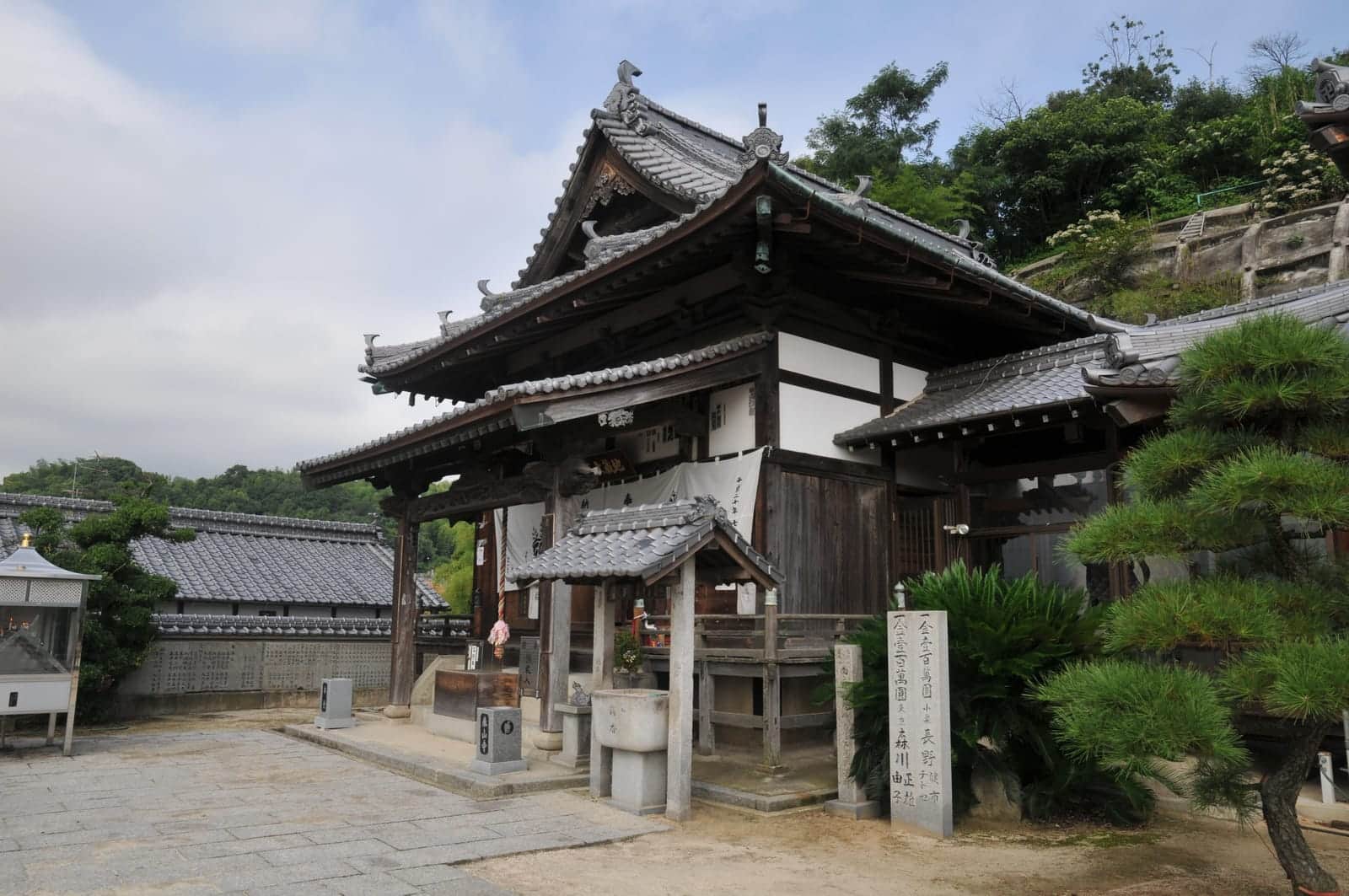
Fire visited repeatedly. Each time, the temple was rebuilt. In 1727, after one such destruction, the complex was relocated to its current position at the foot of Mt. Chikamiyama, the site it has occupied ever since.
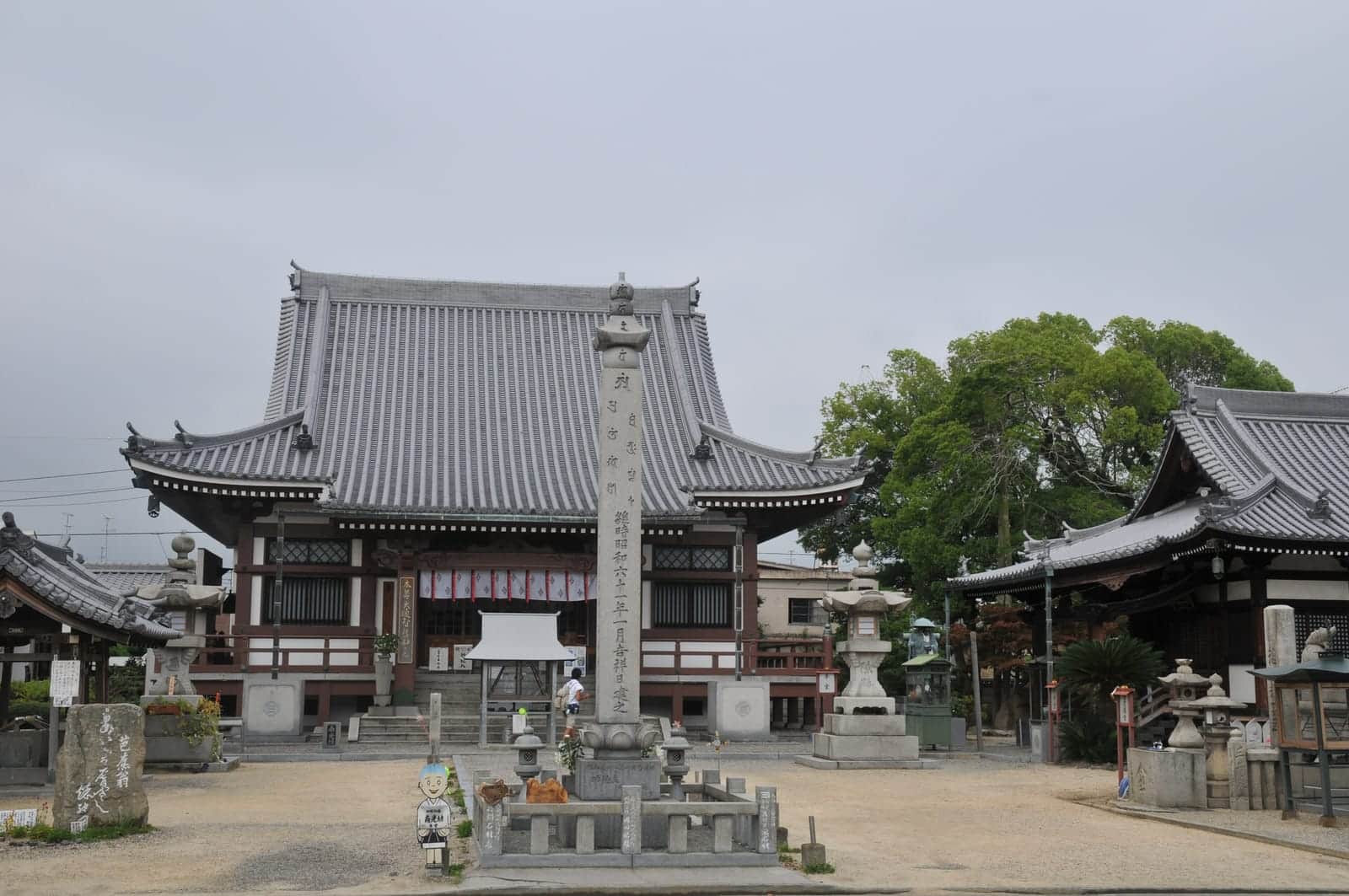
The temple gate is the first thing that stops you. Built entirely of zelkova wood, it was not originally a temple gate at all. It served as one of the gates of Imabari Castle until the early Meiji period (1868 to 1912), when the castle was demolished and the gate was brought here. Standing beneath it, you are passing through a piece of feudal military architecture repurposed for Buddhist devotion, a transition that feels entirely natural in the layered context of Japanese history. Free parking is available just past the adjacent Niomon Gate, and the approach is notably level, making the temple accessible at a genuinely unhurried pace.
Inside the main hall, the Hifuse Fudoson commands attention. What makes this statue unusual, even among the many Fudo Myoo images on the Shikoku circuit, is that it wears a crown, a rare iconographic feature for a deity more commonly depicted with wild hair and a fierce, unadorned expression. The name "Fire Fighting" was given not as a metaphor but as a record: this image survived the fires that destroyed the buildings around it, again and again.
The Shikoku 88 Temple Pilgrimage, known in Japanese as the Ohenro, traces a roughly 1,200-kilometer circuit around the island of Shikoku, following in the spiritual footsteps of Kobo Daishi. Enmei-ji, as Temple 54, sits in the stretch of the pilgrimage that passes through Imabari, and pilgrims who have walked the long coastal and mountain sections before this point often arrive here in the late afternoon, tired but still moving. The temple's goshuincho office (the stamp office where pilgrims receive their official seal and calligraphy) has earned a strong reputation among both Japanese and foreign henro for its warmth and the range of pilgrimage supplies it stocks, including items that can be difficult to find outside of major cities.
The temple also holds the second oldest Shinnen signpost in Shikoku, one of the stone pilgrimage markers created by Yuben Shinnen in the late 17th century. These markers were among the first systematic attempts to guide pilgrims along the route, and finding one here, still standing, connects the modern visitor to the earliest organized era of the Ohenro tradition.
In the precincts, the tomb of Ochi Magobei marks a different kind of devotion. Magobei was a village headman in Agata who, during the devastating Kyoho famine (1716 to 1736), worked to save local farmers from starvation. His grave here suggests the temple served not only as a religious center but as a place where civic memory was honored and preserved.
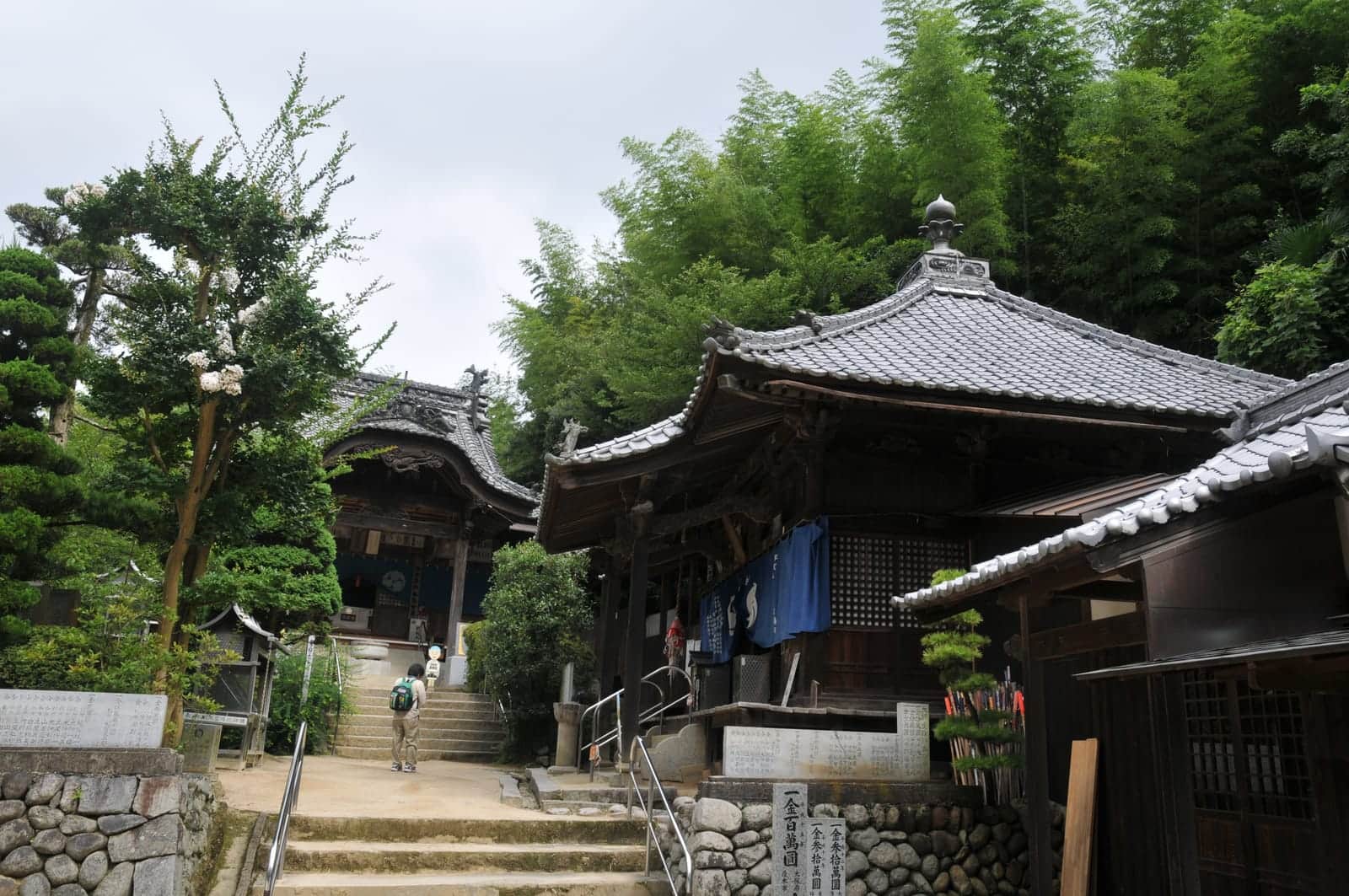
Spring brings a particular reward. A Japanese andromeda tree in the temple grounds produces small, delicate white flowers for roughly a month each year, the kind of quiet seasonal beauty that rewards visitors who arrive outside the peak autumn and cherry blossom windows. The setting at the foot of Mt. Chikamiyama is gentle rather than dramatic, the mountain rising behind the compound without overwhelming it, giving the whole site a sense of shelter and enclosure that feels appropriate for a place dedicated to prolonging life.
An informal tradition has grown up around this temple that no official source fully captures. One long-term resident near Imabari has spent years meeting foreign pilgrims as they arrive, recording their visits in a personal logbook, functioning as what one visitor called an unofficial ambassador to foreign henro. It is the kind of human detail that accumulates around places where people keep returning, generation after generation, looking for something they cannot quite name but recognize when they find it.
The principal image is a rare crowned Fudo Myōō statue that has miraculously survived multiple temple fires, earning it the nickname 'Fire Fighting Fudo.'
Enmei-ji has been rebuilt multiple times after fires; its current site was established in 1727.
This temple offers 1 different goshuin designs
Same as opening hours
Regular
Seasonal celebrations and special occasions
Not confirmed
More ways to continue from this place.
Within 300 m Within 600 m
Imabari, Ehime Prefecture
1 recent posts
Share how your visit was to help other travelers.
 PA
PAPablo Arrieumerlou shared a goshuin