
Visite entre semana en lugar de fines de semana o Días del Perro (inu no hi, cada 12 días), cuando el santuario se llena de madres embarazadas buscando bendiciones para un parto seguro.
De un vistazo
A shrine where an expectant mother, a delicate child, and an entire city’s faith meet in one place does not announce itself loudly, but Suitengu has long drawn people for reasons that are deeply human, practical, and moving: safe childbirth, child rearing, prayer for children, prosperity, and a sense of protection that has survived fires, earthquakes, relocations, and the pressures of modern Tokyo. The shrine’s present home in Nihonbashi Kakigaracho is only the latest stage in a story that began in Kurume, Fukuoka, and then moved through the private precincts of a daimyo residence before becoming one of the most widely visited sacred sites in the capital. Today’s precincts reflect that layered past with unusual clarity. You can see old devotion expressed through white timbered architecture, traditional metal fittings and carvings, and also through a strikingly modern base-isolation structure designed to protect the shrine from major earthquakes.
The origins of Suitengu lie in the Kurume domain in what is now Fukuoka Prefecture. The Tokyo shrine began in 1818, when the ninth lord of Kurume, Arima Yorinori, moved the shrine deity from the family’s domain shrine to the upper residence in Mita Akabanebashi in Edo. From that point, Suitengu became closely linked with the Arima clan, whose devotion was inherited from their ancestral line. The family traced its spiritual identity back to Ariake or Arima Shrine and to the deity Amenominakanushi no Okami, and they preserved that connection through the use of the mitsudomoe crest, which the family adopted as its own. Even now, according to the shrine’s tradition, only the head of the family may bear that crest.
The Arima story itself is part of the shrine’s historical depth. The family descended from the Satsuma Arima line, related to the Akamatsu, and after the Kakitsu War of 1441, during the turbulent aftermath that helped lead toward the Onin War, they fled to the Arima district in present-day Kobe and took the name Arima from that place. Later, they were recognized by Toyotomi Hideyoshi and restored to prominence. Their long memory of divine favor became central to Suitengu’s identity.
In 1620, when Arima Toyouji received Kurume Domain with an income of 210,000 koku, the second lord, Arima Tadayori, donated a large tract of land facing the Chikugo River and had a shrine built there for what was then reverently called Nimo Gozen Daimyojin. Centuries later, the same family brought that devotion to Edo so that they could worship more easily while serving in the shogunal capital. The shrine’s popularity among townspeople grew quickly. During the Edo period, people even tossed offerings over the fence, so the lord opened the gates only on the 5th day of each month, allowing the public to pray. That generosity gave rise to the famous phrase “Nasake Arima no Suitengu,” a pun on the family name and its reputation for compassion.
The shrine’s later history mirrors Tokyo’s own upheavals. It moved to Aoyama in 1871, then to Nihonbashi Kakigaracho in 1872. It endured the Great Kanto Earthquake and other hardships. In modern times, it marked 200 years since the Edo establishment with a commemorative celebration on May 3, 2018, following a major rebuilding project completed in April 2016.
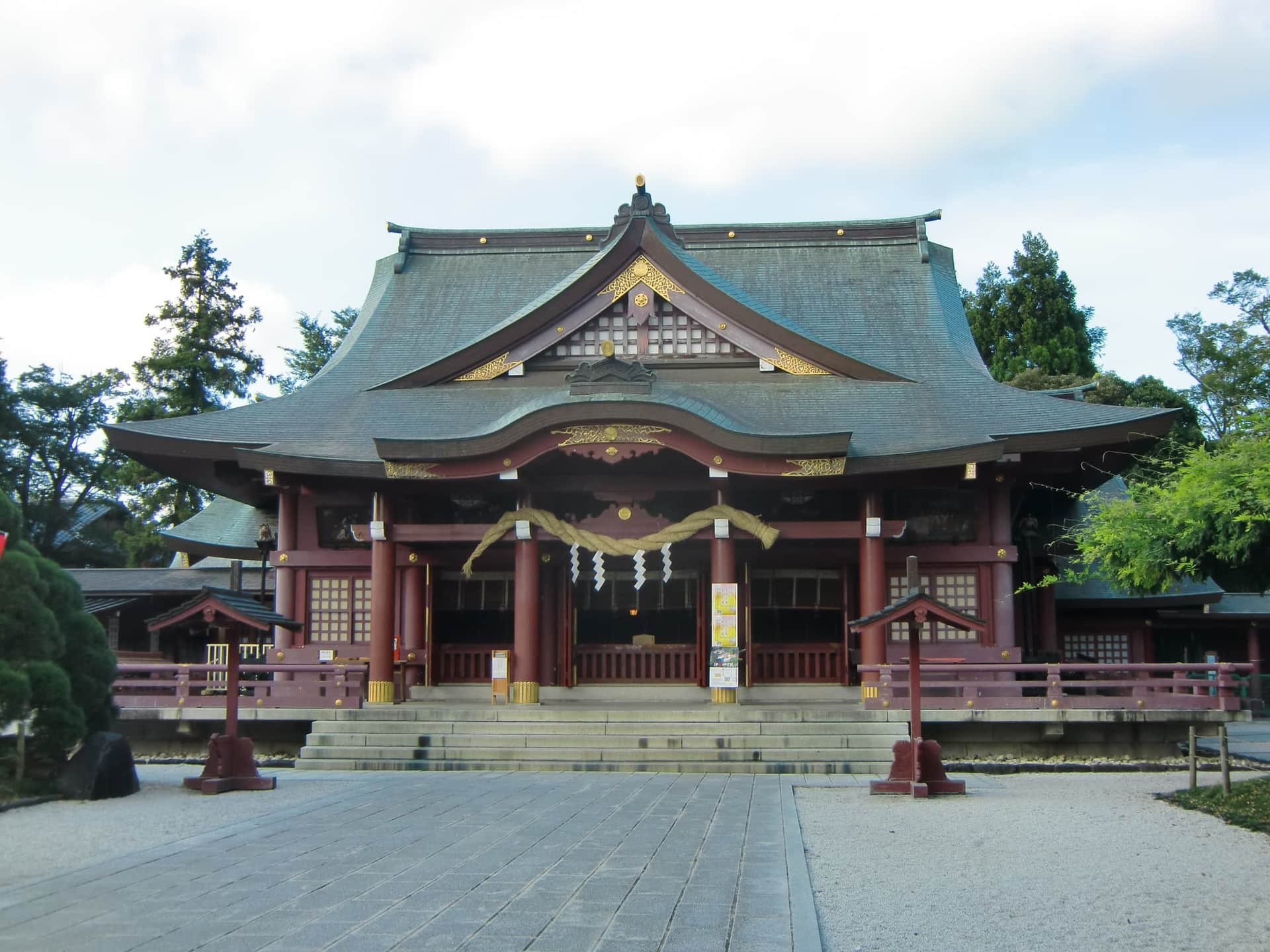
What visitors encounter now is the result of a major three-year reconstruction that combined tradition and contemporary engineering. The main shrine buildings and the sanpaijo or reception hall were rebuilt as part of the Edo relocation 200-year memorial project. The new shrine complex uses a Shinto architectural style in the main sanctuary, expressed through white timber, a calm and luminous finish, and carefully preserved decorative arts such as metal fittings and carved ornament. The effect is dignified rather than grandiose, and that restraint suits the shrine’s character well.
The reception hall introduces a more modern note. It incorporates contemporary architecture while harmonizing with the shrine proper, so the whole complex feels like a dialogue between inherited form and present-day function. Beneath it all is a base-isolation system engineered for safety. The shrine explains that in the event of a major earthquake, the building may move horizontally by about 60 centimeters, reducing shaking. To accommodate that movement, the grounds include a narrow planted trench-like zone along the first-floor corridor, and visitors are warned not to stand there during seismic activity. The design is both technically sophisticated and symbolically apt: a sacred place devoted to protection is itself protected with cutting-edge engineering.
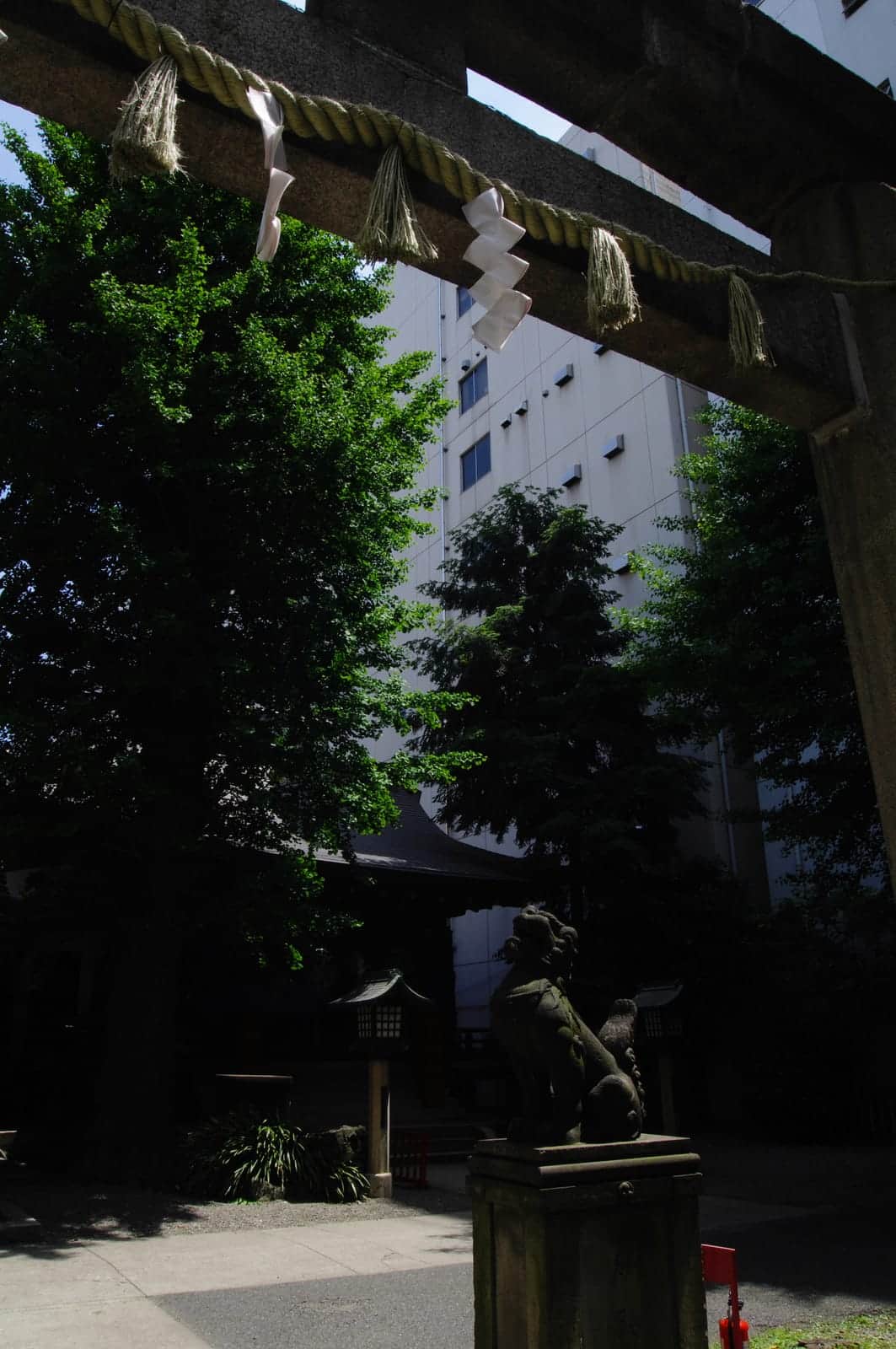
Several sculptural details enrich the grounds. The famous child dog statue presents a mother dog gazing at her pup, surrounded by the twelve zodiac animals. Visitors believe that touching their own zodiac figure brings blessings for safe delivery, childbearing, and healthy growth. Another notable pair is the komainu, one with an open mouth, the other closed, expressing a-un, the inhalation and exhalation of life, and serving as guardians against evil. There is also the charming parent and child kappa sculpture, with baby kappa clinging to its parent’s shoulders, back, and chest, a quietly affectionate image that has become one of the shrine’s memorable visual signatures.
Suitengu enshrines four deities. The first is Amenominakanushi no Okami, described in the shrine’s own teaching as a primordial deity who appeared at the highest point of heaven at the beginning of the cosmos. This deity is linked with the ancestry of the gods and with wide-ranging blessings for safe childbirth and conception. The shrine also enshrines Emperor Antoku, Kenreimon-in, and Nii no Ama, figures connected to the tragic end of the Heike at Dan-no-ura. Their presence gives Suitengu a layered identity, one in which birth, loss, lineage, and prayer are all held together.
The shrine’s calendar is unusually rich. Monthly festivals are held on the 1st, 5th, and 15th. The 5th is especially important, because of the old custom that allowed worship only on that day in Edo. The shrine also observes the first Suitengu of the year on January 5, known as Hatsu Suitengu, and the year-end Suitengu on December 5, both still cherished as special days of devotion. The most important annual festival is the May 5 Grand Festival, a day that resonates with the shrine’s deep association with the number 5.
Other rites shape the year. On Doyo no Ushi no Hi, the ox day that recurs every twelve days, the shrine is especially crowded with visitors praying for childbirth and maternity protection. On Mino no Hi, also every twelve days, the doors of the sanctuary are opened so that people may view the divine image associated with Housho Benzaiten, the deity of learning, the arts, and wealth. Seasonal rites include Setsubun on February 3, with bean scattering for the expulsion of evil and the invitation of good fortune; Kinen-sai on February 17, the prayer for a bountiful harvest; Takao Shrine Festival on March 4, for the deity of rain; spring and autumn ancestral rites on the equinoxes; the All Japan Disaster Recovery Prayer Festival on March 11 at 2:46 p.m.; Summer Purification on June 30; Autumn Kibune Festival on November 18, for the deity of fire prevention; Niiname-sai on November 23, thanksgiving for the new harvest; and New Year’s Eve Purification on December 31.
There are also more intimate rituals, including tea offerings to the deities. These are conducted with the help of the Urasenke school, and during nodate, shrine maidens prepare matcha for visitors for a fee.
Although Suitengu is in the middle of Tokyo, its atmosphere is not urban in the usual sense. The shrine has been shaped to create a sense of calm arrival. The sloping approach from the waiting room to the sanctuary is gentle, and large windows allow soft light to fall across the interior while giving a broad view of the precincts. The waiting room itself is bright and open, with digital displays that explain the shrine’s history and show footage of major festivals from the early Showa period. There is even a nursing room, which fits the shrine’s family-centered role.
The setting is not a landscaped garden in the classical sense, but its design carefully supports the mood of prayer. The white wood, the soft light, the sculptural animals, and the restrained use of space all work together to create a place that feels protective rather than ceremonial in a distant way. For many visitors, that is exactly the point.
A visit to Suitengu today is both practical and emotional. At the shinzasyo or amulet office, visitors can receive omens, prayer services, and goshuin. On certain days the shrine becomes especially busy, above all on ox days and at the major festivals. The shrine’s treasure-like presence lies less in display cases than in the living continuity of worship: the same days, the same prayers, the same concern for family wellbeing that drew Edo townspeople and now brings people from across Japan.
What makes Suitengu exceptional is the way it joins old courtly and domain history, popular urban devotion, maternal and child-centered prayer, and modern disaster-resistant architecture into a single functioning shrine. It is at once a site of memory, a place of ritual rhythm, and a very contemporary Tokyo sanctuary where technology serves reverence rather than replacing it.
El clan Arima adoptó el emblema de tres comas del dios Amenominakanushi del santuario Arima tras ser rescatados por Toyotomi Hideyoshi, creyendo que el dios les otorgó fortuna. Solo el jefe actual puede usar este símbolo sagrado.
La estatua "Kodakara Inu" (perro tesoro infantil) fue donada por Shojiro Ishibashi, fundador de Bridgestone. Los visitantes frotan su animal zodiacal entre los 12 signos alrededor de la madre de bronce para bendiciones de parto seguro y niños sanos.
Este santuario ofertas 1 diferentes diseños de goshuin
Igual que el horario de apertura
Regular
Instalaciones
Visite entre semana en lugar de fines de semana o Días del Perro (inu no hi, cada 12 días), cuando el santuario se llena de madres embarazadas buscando bendiciones para un parto seguro.
Visita el día 5 de cada mes o en los Días de la Serpiente (mi no hi, cada 12 días) para ver las puertas del santuario Hosho Benzaiten abiertas y contemplar la estatua de la deidad en su interior.
Toca tu animal zodiacal en la estatua del Perro Tesoro Infantil (Kodakara Inu) para bendiciones de parto seguro, fertilidad y desarrollo saludable del niño. Esta estatua de bronce, donada por Ishibashi Shojiro, fundador de Bridgestone,...
El santuario ofrece acceso por ascensor desde el estacionamiento al área principal de culto, siendo totalmente accesible para mujeres embarazadas y familias con niños pequeños sin necesidad de subir escaleras.
Tenga en cuenta que este es principalmente un sitio de culto para eventos vitales, no un santuario tradicional, con arquitectura moderna que integra edificios del santuario en una estructura contemporánea terminada en 2016.
Durante las ceremonias formales de oración (gokito), el sacerdote del santuario y la miko llaman a cada mujer embarazada por su nombre y realizan rituales de purificación con campanas sagradas en un ambiente solemne.
Los espíritus divinos venerados en este lugar sagrado.
2 estructuras en el terreno
Built in traditional shrine architectural style with white wood as the base, incorporating decorative metalwork and carvings passed down through generations. Features modern seismic isolation technology.
Modern architecture that harmonizes with the shrine building through advanced design. Improved waiting room environment.
Celebraciones estacionales y ocasiones especiales.
Chuo, Tokyo Prefectura
Más páginas relacionadas con este lugar.
Lo que se cree que concede este lugar
0 publicaciones recientes
Comparte cómo fue tu visita para ayudar a otros viajeros.
Todavía no hay publicaciones públicas de la comunidad.
Menos de 300 m Menos de 600 m
Datos de horarios: Public Transportation Open Data Center
El alquiler requiere la app del operador y un número de teléfono japonés. Los pases de un día de docomo se venden en tiendas de conveniencia. Fuentes de datos