이 페이지의 내용
핵심 요약
- A public catalogue built around individual goshuin designs, with permanent IDs, verification, citations, and room for deeper research.
- The Goshuin Database, announced on August 1, 2026, gives individual goshuin designs a public record of their own. Goshuin (御朱印, goshuin) are the calligraphy and seal records received at Japanese temples and shrines.
- A visit photograph captures a personal moment. A catalogue record gives a design a shared reference. It brings together the issuing place, distinguishing features and the evidence behind the description.
The Goshuin Database, announced on August 1, 2026, gives individual goshuin designs a public record of their own. Goshuin (御朱印, goshuin) are the calligraphy and seal records received at Japanese temples and shrines. The database documents the design itself, independently of any one collector's visit.
Begin with the goshuin
A visit photograph captures a personal moment. A catalogue record gives a design a shared reference. It brings together the issuing place, distinguishing features and the evidence behind the description.
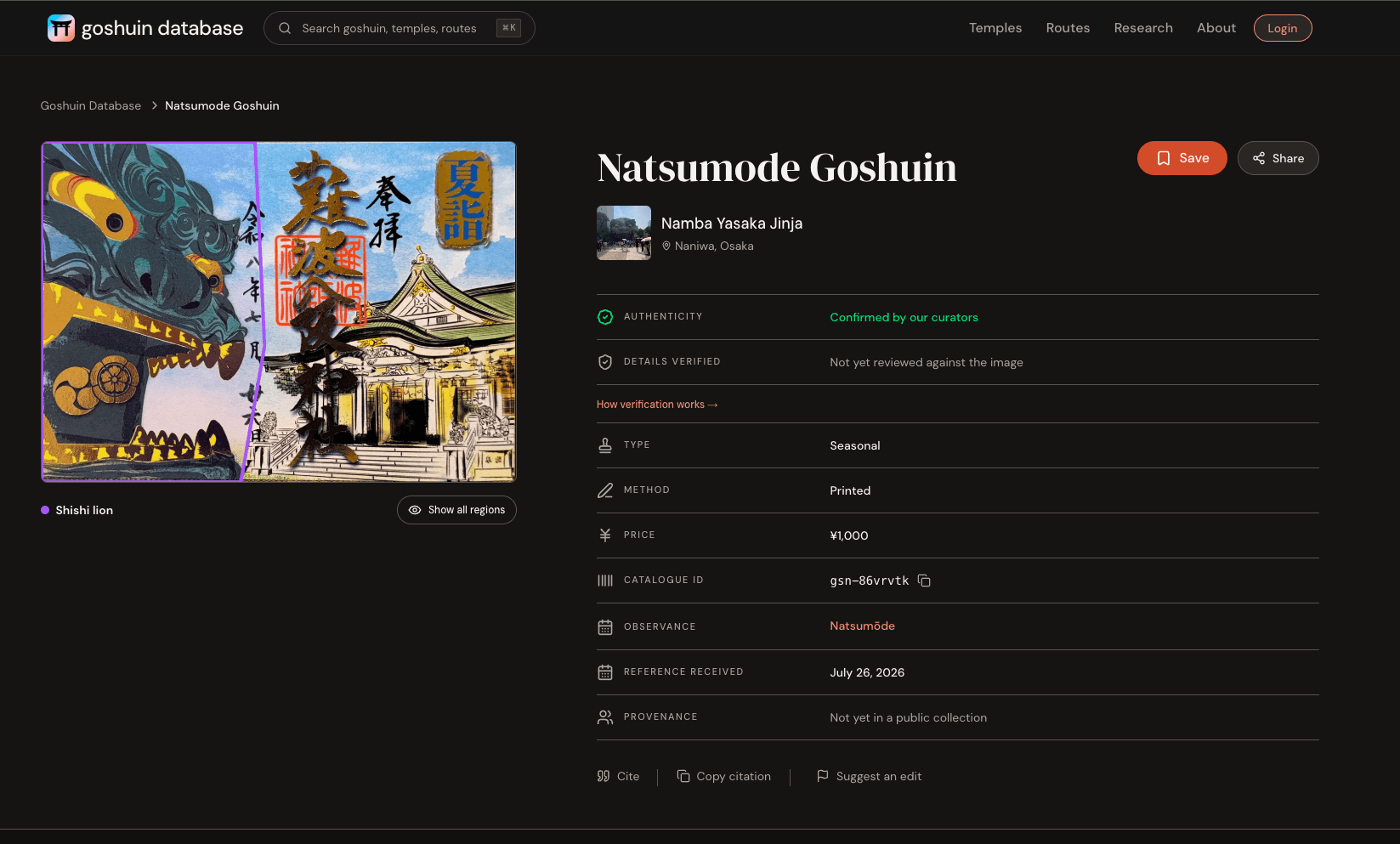
The launch featured the Natsumode Goshuin from Namba Yasaka Jinja. It is an example of how a record can connect an image with structured details rather than leaving a reader to interpret the photograph alone.
The record featured in the launch announcement. Values in this screenshot reflect the captured page, not a current availability promise.
A permanent identity for each design
Every distinct design receives a permanent Catalogue ID, such as gsn-86vrvtk. These IDs are non-sequential and are never reused or reassigned.
If two entries turn out to describe the same design, they can be merged while the earlier identifier continues to lead to the surviving record. That matters when someone has already cited, bookmarked or printed a reference.
Research grows one record at a time
Records can describe the issuing temple or shrine, verification status, type, production method, observance and provenance. Further research adds visible motifs, physical details, Japanese inscriptions, readings, meanings and seals.
Not every record begins with the same depth of analysis. The catalogue is built progressively. Its methodology explains how verification and provenance are presented so readers can assess the evidence.
The analysis section shown in the launch announcement, from motifs to seals.
For background on the practice, read our introduction to goshuin and guide to seasonal designs.
A foundation for preservation
The database is also a starting point for the longer-term Goshuin Open Archive. Catalogue facts can be documented now; preserving and sharing images requires the appropriate rights or permission.
Those are related responsibilities. A useful record should remain traceable, while the work of photographers, collectors and issuing temples or shrines is respected.
Explore a record
Start with the Goshuin Database, open a design and follow its issuing place. Compare what is documented with what still needs research.
The August announcement also described a future mobile app without a release date. That was a development plan, separate from the public database introduced here. The work already available is the catalogue: a place to find, understand and cite a goshuin design.