
Regular
At a Glance
A quiet stone path leads you into the very house where a celebrated general and his devoted wife ended their lives—an act of loyalty that shocked a nation and still radiates moral and historical complexity. Here in central Tokyo’s Minato ward, the serene precincts of Nogi Shrine—formally Nogi-jinja—enshrine the spirits of General Nogi Maresuke and Nogi Shizuko as Shinto kami. Founded on November 1, 1923, the shrine stands on the couple’s former residence, a unique compound where a Meiji-period example of Western architecture survives alongside traditional sacred structures. The site is inseparable from the date September 13, 1912, when, upon the death of the Meiji Emperor, General Nogi and his wife chose ritual death, a culmination of lifelong ideals. The original shrine was later destroyed in the May 25, 1945 air raids; what you see today was rebuilt in 1962—a postwar reassertion of memory and meaning.
Walk back to the turbulent turn of the century and you encounter a figure emblematic of Japan’s rapid transformation: General Nogi Maresuke (1849–1912), an officer whose service and personal austerity made him a national symbol. His wife, Nogi Shizuko (1856–1912), shared his convictions and, in death, his fate. Their final act occurred on September 13, 1912, the very day of the Meiji Emperor’s funeral. To contemporaries, it was framed as a starkly traditional gesture of loyalty—what later commentators would call an echo of junshi (following one’s lord in death). To others, it was a deeply controversial act, exposing the tensions and contradictions of modernization.
In the immediate aftermath, civic leaders sought a place where the public could grieve and reflect. The Tokyo Mayor, Baron Yoshio Sakatani, convened the Chūō Nogi Kai—the Central Nogi Association—with a clear mission: to build a shrine to the couple within the grounds of their residence. This decision enshrined not only two individuals but also a national conversation about duty, modernity, mourning, and the shape of public memory. Officially established on November 1, 1923, Nogi-jinja opened as a dedicated site of veneration to the Nogis as kami, a gesture rooted in longstanding Shinto practice of deifying exemplary human figures, much like the venerations of Sugawara no Michizane at Tenmangū shrines or Tokugawa Ieyasu at Tōshōgū.
The shrine’s early decades were shadowed by the seismic events of modern Tokyo. Much of the city suffered from fire and war, culminating in the devastating air raids of May 25, 1945, when the original shrine buildings were destroyed. Yet the story did not end with wartime loss. In 1962, the present shrine complex was built, inheriting the founding spirit of the 1923 establishment and restoring the site as a public locus of memory. This arc—founding after 1912, destruction in 1945, rebuilding in 1962—places Nogi-jinja alongside many Tokyo shrines that embody resilience: a city and a tradition repeatedly remade, yet rooted in deep continuities.
The resonance of the Nogis reaches far beyond Tokyo. Across Japan, multiple shrines honor their memory. Among them are sites in Nasushiobara (in Tochigi Prefecture), Fushimi-ku (Kyoto), Shimonoseki (Yamaguchi Prefecture), and Hannō (Saitama Prefecture). These dispersed sanctuaries mark a nationwide memorial geography, signaling the uncommon cultural weight of the Nogis’ story and the pliability of Shinto in accommodating modern historical figures into its pantheon of kami.
The power of Nogi-jinja lies not solely in narrative; it resides in the compound’s built fabric. Uniquely, the precinct incorporates a rare Meiji-period Western-style residence, preserved as part of the shrine grounds. This house—quiet, severe, and elegant—speaks the language of late nineteenth- and early twentieth-century Western design: balanced proportions, formal symmetry, and a reserved palette of materials. With its rectilinear massing and restrained detailing, it stands as an artifact of the Meiji period’s embrace of Western forms in education, military, and civic architecture. Entering this structure, you sense how imported aesthetics were naturalized into Japanese life, from floor plans that follow Western domestic logic to fenestration and finishes that depart from traditional Japanese timber halls.
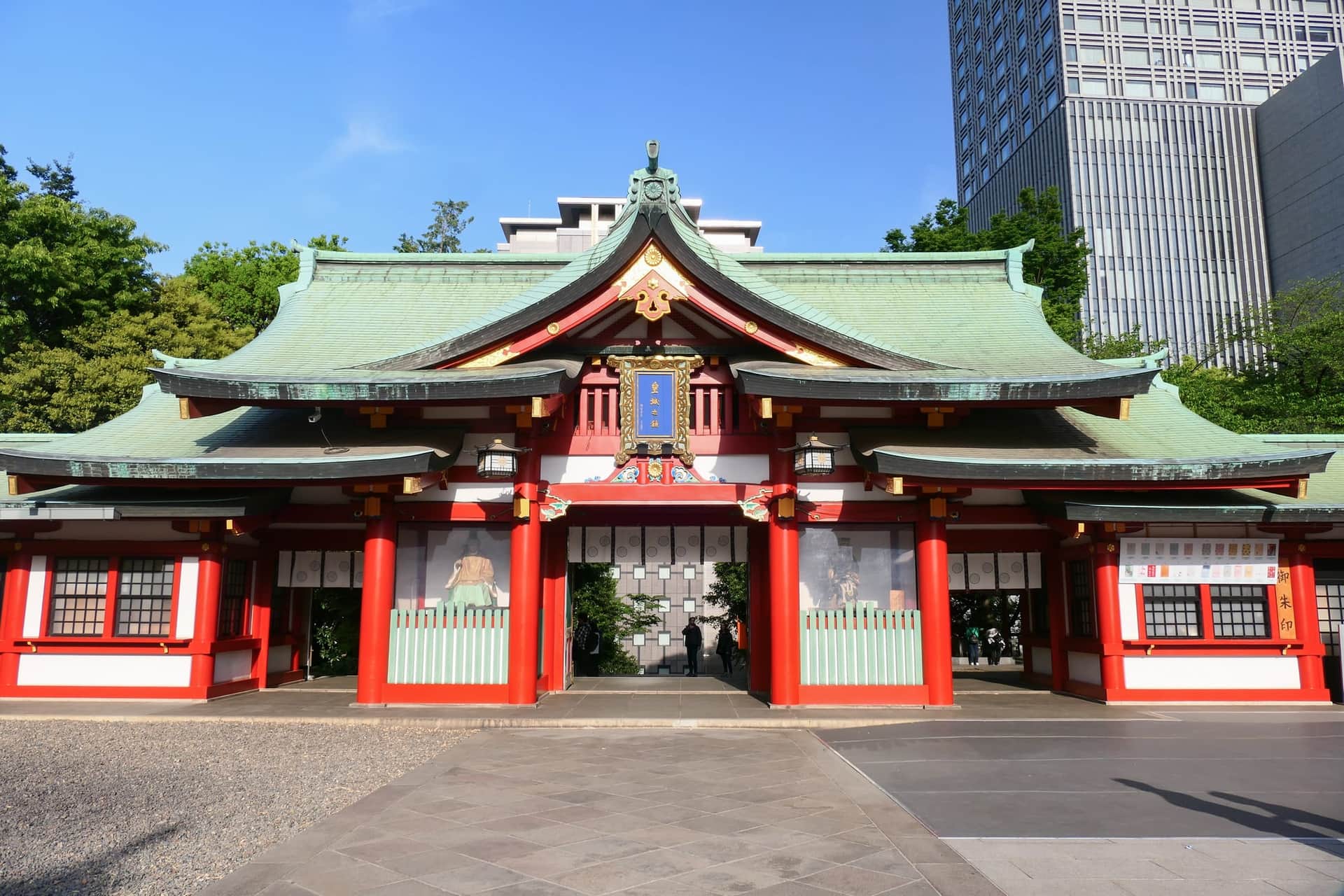
To step back outside is to re-enter a different grammar of space. The rebuilt 1962 shrine buildings return you to the language of Shinto: an axis oriented to a torii gate, a ritual approach leading toward the haiden (worship hall) and ultimately the honden (sanctuary). These structures are crafted in timber, as befits shrine architecture, their surfaces and joinery reflecting a continuity of carpentry practice that reaches back many centuries. The roof profiles sweep with a quiet authority, catching light and shadow throughout the day; roofing material in postwar reconstructions often employs copper alloy or tile, marrying durability with traditional silhouette. The spatial sequence—passing from the urban bustle through the torii, to the ablution at the temizuya (purification basin), to the hush of the haiden—is choreographed to decelerate your pace and focus attention.
Detail is not an afterthought here. Carved transoms, latticework screens, and the soft sheen of polished wood contribute to the shrine’s understated dignity. The precinct is calibrated for ceremony: a forecourt capable of receiving worshippers, a haiden scaled for both individual prayer and communal ritual, and a honden enclosed and consecrated, accessible only to priests. It is in this carefully tiered arrangement that Shinto’s architectural logic reveals itself—an architecture of invitation and threshold, culminating in the unreachable sanctum where the enshrined kami reside.
One of the most arresting spaces is the shrine’s treasure museum, where, at carefully circumscribed times, the blades associated with the Nogis’ deaths are displayed. These artifacts—shown only three times a year, on New Year’s, during the Worshippers’ Grand Festival in spring, and at the Annual Autumn Festival—are handled with formal reverence. The museum’s controlled lighting and cases do not sensationalize; rather, they frame the objects as relics of moral decision and national debate. Their measured display schedule underscores the shrine’s ethic: to remember without spectacle, to commemorate without easy answers.
Taken together, the compound’s architectural ensemble—Western residence and Shinto sanctuaries—synthesizes the contradictions of the Meiji and Taishō eras. Here, two architectural idioms stand in deliberate relation, translating a personal story into spatial form. The result is a site whose power is cumulative: the more time you spend with the buildings, the more its quiet coherence emerges.
While visitors often come for history, they encounter a living religious site. In Shinto, to enshrine human beings as kami is neither unprecedented nor superficial. It is a way of acknowledging exemplary lives that, in Japanese cultural logic, continue to act within the world. At Nogi-jinja, the enshrined couple are venerated for their integrity, frugality, and sense of duty—values widely promoted in the late Meiji and early Taishō periods and still debated today.
The Nogis’ deaths on September 13, 1912, the day of the Meiji Emperor’s funeral, were interpreted by many of their contemporaries as the ultimate expression of loyalty to the sovereign. Others viewed the act with unease, seeing it as a vestige of an earlier feudal ethic incompatible with modern life. The fact that Nogi Shizuko chose to die with her husband complicates the narrative further, inviting discussion of marital devotion and gendered expectations. Rather than dictate a single interpretation, the shrine’s religious framing allows worshippers to bring their own intentions: to pray for strength in duty, to seek clarity in moments of moral crossroads, to honor the continuity of family, or to reflect on the costs of idealism.
Ceremonially, the shrine’s calendar is anchored by the three public display periods of the blades: New Year’s, the spring Grand Festival, and the Autumn Festival. Each is a hinge in the ritual year. New Year’s draws people seeking renewal and good fortune, a nationwide practice known as hatsumōde. The Worshippers’ Grand Festival in spring celebrates gratitude and community ties, while the Annual Autumn Festival often coincides with the season when, culturally, remembrance and harvest intertwine. During these times, the shrine functions as a stage for formal rites led by clergy: purification, offerings of rice and sake, prayers intoned at the haiden, and the dignified soundscape of kagura instruments when traditional dance is performed.
The wider network of Nogi Shrines—in Nasushiobara, Fushimi-ku (Kyoto), Shimonoseki (Yamaguchi), and Hannō (Saitama)—reinforces how the couple’s memory moved into the national religious sphere. Each branch shrine adapts the veneration to a local context, but the underlying idea is shared: the Nogis as moral exemplars whose virtues can be entreated in prayer. In this way, Nogi-jinja participates in a broader Shinto pattern where individuals become conduits of blessing and instruction, not abstract symbols but active presences.
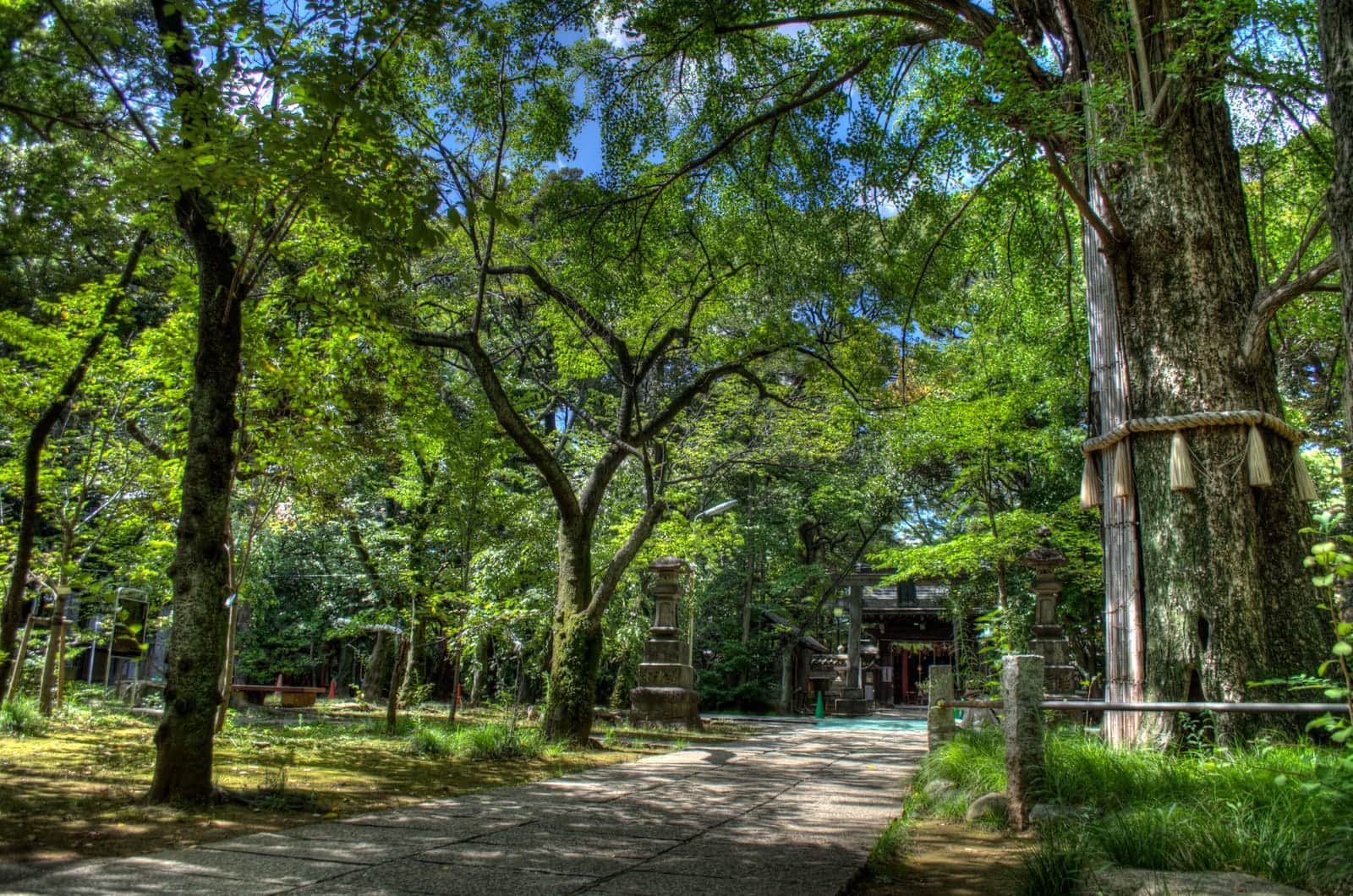
Though only steps from busy avenues and subways, the precinct’s microclimate is defined by shade, gravel, and seasonal color. The approach is marked by a torii that frames a modest canopy of trees; branches filter the urban glare into moving patches of light. This interplay matters. In Shinto, the natural world is not a backdrop but a participant, and the landscaping supports the shrine’s purpose: to create an interval of quiet inside the city’s pulse.
Through spring, young leaves soften the architecture’s lines; in summer, the foliage thickens, muffling sound. Autumn brings burnished tones to the grounds and sets the stage for the Annual Autumn Festival and its associated displays. Winter clarifies the forms: the sweep of the roofline, the clean planes of the timber walls, the purposeful geometry of pathways. Even when floral display is sparse, the shrine’s sensory field is rich: the crunch of gravel underfoot, the scent of wood after rain, the faint metallic note of the suzu bell when worshippers approach the haiden.
The presence of the Meiji-period Western house adds another layer to the landscape. Its geometry contrasts with the organic curves of shrine roofs and the informal drifts of planted shrubs. Viewed from the path, the residence reads as a quiet sentinel of history, its windows and doors calibrated to human scale, its silhouette revealed differently by each season’s light. The tension between these two architectures—the Western domestic and the Shinto sacred—creates a site where modernity and tradition meet in the sensory present.
Arriving today, you pass beneath the torii and perform a simple purification at the temizuya—scooping water to cleanse hands and mouth, an act less about hygiene than about preparing mind and spirit. In front of the haiden, visitors bow, ring the bell, offer coins, clap twice, and bow again—gestures that are at once structured and intimate. The shrine is active, but unhurried; most days you’ll share the space with office workers on lunch break, families marking life events, and travelers grateful for a pocket of stillness.
On designated days—the New Year period, the Worshippers’ Grand Festival in spring, and the Annual Autumn Festival—the treasure museum opens to display the blades used in the Nogis’ suicides. These occasions are powerful and quiet. People stand in contemplation, encountering not just metal but the dense moral questions embedded in it. The museum’s role is not to shock but to witness, reinforcing the shrine’s identity as a place of memory.
Elsewhere in the precinct, the Meiji-period Western residence draws visitors curious about domestic architecture of the age when Japan deliberately engaged Western styles. Even without entering, the house’s exterior communicates the era’s careful borrowing: symmetry, measured ornament, and a self-consciously “modern” aura. Standing between the residence and the shrine, you inhabit the hinge of two stories—the nation’s transformation and the personal choices that transformation provoked.
The rebuilt 1962 shrine pavilion demonstrates postwar craftsmanship and restraint. While it does not claim the age-patina of premodern timber, it articulates continuity through form and function: a honden that remains hidden and holy; a haiden that invites approach; ritual furniture aligned precisely; and a precinct that functions in tune with the liturgical calendar. Photographers often find themselves drawn to the meeting points—where wood meets sky, where the torii frames modern buildings beyond, where the Western house’s straight lines set off the shrine’s curves.
Although not a UNESCO site or a National Treasure in the formal sense, Nogi-jinja is a recognized and respected locus of cultural memory. Its power is cumulative, the kind that grows each time you connect a date to a structure: September 13, 1912 to the residence; November 1, 1923 to the shrine’s founding; May 25, 1945 to the air raids; 1962 to renewal. In a city of constant change, those dates anchor the place.
Practical rhythms shape the visit. Mornings tend to be quietest. Midday light pours across the forecourt, sharpening the shadows cast by rails and rafters. Late afternoon deepens the colors of timber and foliage. When the museum exhibits the blades, expect more visitors, but also a hush—people come to look, and to think. If your timing aligns, attending a seasonal festival reveals the site in its full ceremonial life: priests in white robes and tall black hats, norito prayers rising in measured cadence, and offerings placed with exacting care before the kami.
Beyond Tokyo, the existence of sister shrines in Nasushiobara, Fushimi-ku (Kyoto), Shimonoseki, and Hannō testifies to the breadth of the Nogis’ legacy. Some visitors make a point of seeking out more than one, tracing a personal pilgrimage through the archipelago. Doing so illuminates how regional communities have shaped the memory of the Nogis in their own contexts, while the Tokyo shrine remains the emotional center, rooted in the very ground where the couple lived and died.
The most poignant way to leave the precinct is to return to the beginning: the Western house, the torii, the path back to the city. At Nogi-jinja, architecture is not merely background; it is the medium through which the past speaks. By enfolding a Meiji Western residence and a Shinto shrine into one sacred precinct, the site embodies Japan’s modern paradox: a culture that learned to carry tradition forward by accommodating the new, and to accommodate the new without forgetting the obligations of the past.
As you step back onto the sidewalk, consider how the shrine reconciles opposites. It memorializes a controversial act without instructing you what to feel. It honors the Nogis as kami while welcoming the skeptical. It sits in Minato, among offices, apartments, and cafés, yet holds itself apart, its gravel and timber warm with attention. The dates—1912, 1923, 1945, 1962—are more than markers. They are a rhythm, the rhythm of loss and rebuilding that furnished modern Tokyo not only with buildings, but with meanings. And in that rhythm, Nogi-jinja remains steady: a place to bow, to breathe, to face history, and to walk on more awake than before.
The shrine houses a sacred "kai" tree, the very tree that gave the kanji character for "kaisho" (block script) its name, making it a living symbol of proper calligraphy.
The shrine was built on the very site where General Nogi and his wife committed ritual suicide on September 13, 1912, the day of Emperor Meiji's funeral. The blades used are displayed just three times yearly.
This shrine offers 6 different goshuin designs
Same as opening hours
Regular
Regular
Regular
Regular
Regular
Regular
The shrine is located directly next to Nogizaka Station (Exit 1 on the Chiyoda Line), making it incredibly accessible - just 0 minutes walk from the station and within walking distance of Roppongi Midtown.
Prayer ceremonies (gokitō) take reservations, which helps if you’re visiting for special occasions like safe childbirth prayers (anzan kigan) or other life events, so you can avoid wait times and get guidance.
The flea market is typically held on the 4th Saturday of every month but may be cancelled without notice due to rain or other circumstances. Check the website before visiting.
Visit the preserved historic residence (Nogi-tei) on the shrine grounds, which is the actual home where General Nogi and his wife lived and where they committed ritual suicide (junshi) in 1912.
The shrine's name inspired the nearby slope to be renamed from "Yūrei-zaka" (Ghost Slope) to "Nogi-zaka," which later gave the idol group Nogizaka46 their name. Members regularly visit for hit prayers.
General Nogi's actual residence, a modest French-inspired wooden structure, still stands next door. You can peer inside to see the exact rooms where the couple performed their final act of loyalty.
The divine spirits venerated at this sacred place
12 structures on the grounds
A four-post hip-roof wooden gate with copper roofing, built from Taiwan cypress (Alishan).
Seasonal celebrations and special occasions


Typical Crowds
Peaceful
Visit Duration
45-60 minutes
More ways to continue from this place.
Within 300 m Within 600 m
Timetable data: Public Transportation Open Data Center

C3-32.乃木公園
docomo bike share
C3-06.ホテルアジア会館
docomo bike share
C3-23.LIFORK 南青山 北エントランス
docomo bike share
Renting needs the operator's app and a Japanese phone number. docomo day passes are sold at convenience stores. Data sources
Minato, Tokyo Prefecture
What this place is believed to grant
4 recent posts
5.0
2 reviews
You can reach the shrine in seconds from Nogizaka Station (Chiyoda Line, Exit 1), and Roppongi Midtown is a short walk away. The monthly flea market runs on the fourth Saturday, but it can be cancelled without notice for rain, so check the website before making a special trip.
The preserved wooden residence on the grounds is where General Nogi and his wife actually lived, and where they died by ritual suicide in 1912. You can peer inside to see the rooms.
 HTPro member
Hannah TaylorPro checked in
Welcoming atmosphere. Kind goshuin desk. Helpful and kind. Peaceful atmosphere
Nogi Jinja
Minato, Tokyo
deMauri Mackie checked in
Nogi Jinja
Minato, Tokyo
