Visit in autumn or early morning when the bronze statue and its surroundings create a striking scene. The outdoor setting allows cloud shadows to pass across the Buddha's face, making seasonal changes part of the experience.
At a Glance
You step into a quiet courtyard and meet a gaze that has outlasted storms, tsunamis, and centuries. Before you rises the Great Buddha of Kamakura—the open-air bronze image of Amitābha (Amida) at Kōtoku-in in Kamakura, Kanagawa Prefecture—serene, vast, and impossibly calm. Cast in 1252, this statue is the heart of a Jōdo-shū temple formally known as Kōtoku-in (高徳院), or by its older name Shōjōsen-ji (清浄泉寺) of Daii-zan (大異山). It is a designated National Treasure and one of 22 properties proposed for UNESCO World Heritage listing in Kamakura. The statue stands about 11.3 meters tall, and after the temple’s great hall was repeatedly destroyed—by storms in 1334 and 1369, then a devastating 1498 tsunami—it has remained in the open air ever since: a meditation in bronze beneath the changing sky.
To understand Kōtoku-in, you must see it not just as a single monument but as the distilled spirit of medieval Kamakura Buddhism, a religious landscape shaped by the rise of the warrior government and the search for accessible salvation. The temple belongs to the Jōdo-shū—the Pure Land school founded in Japan by Hōnen—which centers devotion on Amida, the Buddha of Infinite Light, whose western paradise welcomes all who earnestly call his name. This is the meaning that animates the statue: a towering image of Amida that gives form to hope, remembrance, and vows.
The key historical anchor is the casting of the bronze in 1252, during the Kamakura period, a time when new Buddhist movements took root among both elites and commoners. The statue’s sheer scale and refined stillness tell us this was no minor commission: it reflects the wealth, faith, and artistic ambition that defined the age when Kamakura—not Kyoto—was the beating heart of power and culture. The temple’s formal names—Kōtoku-in, and earlier Shōjōsen-ji with the mountain name Daii-zan—place it within the layered naming traditions of Japanese Buddhism, where a living temple may carry multiple titles reflecting its lineage, local geography, and historical identity.
What makes the story of Kōtoku-in unforgettable is the cycle of loss and endurance that followed. The Great Buddha was originally sheltered inside a grand hall, as befits a venerated icon. But the hall succumbed to violent weather not once but multiple times: first destroyed by storms in 1334, rebuilt, and then again destroyed in 1369. Each reconstruction represented the community’s resolve to protect the image; each ruin marked the exposed, coastal realities of Kamakura. Finally, a tsunami in 1498 swept away the hall altogether. The bronze Amida remained, and since that day it has stood beneath the open sky. This transformation—from an indoor image to an open-air icon—has become central to how people experience the statue: as a living companion to wind, light, rain, and passing seasons.
The 20th and 21st centuries brought a new kind of guardianship: scientific conservation and engineering efforts. Sensitive to the realities of earthquakes and coastal weathering, the temple implemented conservation and seismic reinforcement in the 20th century and again in the 21st century. These works, undertaken so the statue can withstand future tremors and continue safely welcoming visitors, are part of a modern stewardship that runs parallel to the centuries-old devotional care. During these initiatives, the statue remained the heart of the temple’s identity: a quiet giant whose preservation is understood as both a cultural duty and a religious offering.
The site’s historical and cultural weight is recognized well beyond Kamakura. The Great Buddha of Kōtoku-in is a designated National Treasure of Japan, placing it among the most revered works in the country’s artistic patrimony. It also forms part of the ensemble of 22 properties proposed for UNESCO World Heritage listing in Kamakura—a reflection of how strongly the city’s medieval heritage continues to shape global understanding of Japanese religion, art, and history.
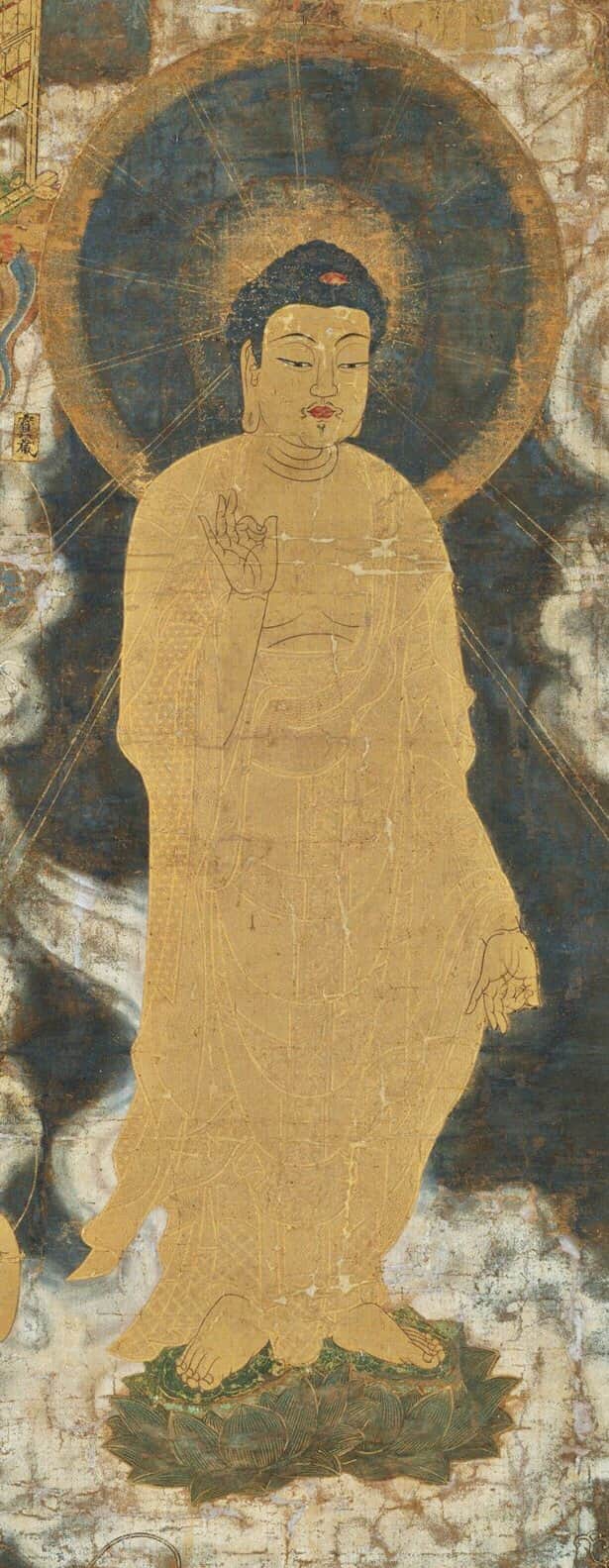
Stand near the statue’s lotus pedestal, and you can feel the design logic at work. This is a bronze Amitābha rendered with disciplined restraint: downcast eyes, a mouth poised in the faintest smile, and the dhyāna mudrā, the meditation gesture, formed by hands folded in the lap. The effect is one of profound self-possession. Even if you know nothing of Buddhism, the sculpture draws you into its composure.
The bronze figure—approximately 11.3 meters tall—would have been cast in multiple sections, a practical method for such a monumental work. The statue is hollow, an engineering choice that reduces weight and distributes stress. Medieval foundry techniques in Japan involved creating molds that could support large panels, which would then be joined, finished, and given their characteristic surface. Over time, the metal has acquired a soft green patina, a visible record of the centuries. Though the original hall is gone, the statue’s exterior reveals subtle traces of its long life outdoors—minute variations of tone, weathering patterns, and the gentle gloss that comes from countless seasons of wind and salt air.
While the original timber hall is lost, the statue’s outdoor presence reveals an architectural intelligence of a different kind. The builders adapted to the open site through careful siting and base construction, anchoring the monument to a firm platform. In an earthquake-prone region, the combination of internal structure and base design is essential. Modern seismic reinforcement—installed in stages across the 20th and 21st centuries—quietly supports the statue today. Although these interventions are discreet, they represent major advances in heritage engineering: they are designed to dissipate seismic energy, stabilize the figure, and protect it from the horizontal motion that has toppled so many historical structures in Japan.
Aesthetically, the statue exemplifies the sober elegance associated with high Kamakura-period sculpture: clear volumes, balanced proportions, and expressively restrained surfaces. Amida’s hair, rendered as tight curls, creates a rhythmic texture that frames the smooth planes of the face. The urna (the auspicious dot on the forehead) and the elongated earlobes signal the Buddha’s transcendent wisdom and renunciation. The robes fall in prescribed folds that read as both physical fabric and idealized geometry; they gather just enough shadow to articulate form without crowding it. From certain angles, the upper torso seems to subtly swell and soften, giving the impression that breath could move through the bronze.
Because the statue was once indoors, its scale was calculated to fill a vast hall. Outdoors, that same scale interacts dynamically with sky and cloud. When seen against passing weather, the Great Buddha’s silhouette becomes architectural—an arch of shoulders and a dome of hair, a temple in itself.
This is first and foremost a Jōdo-shū temple, a community oriented around faith in Amida Buddha, the compassionate figure who vows to welcome beings into the Pure Land—a realm of awakening—through sincere recitation of his name: the nenbutsu. Many visitors will hear the simple chant—“Namu Amida Butsu” (“I take refuge in Amida Buddha”)—offered quietly at the base of the statue or within the precincts of the temple. The Great Buddha of Kamakura is not merely a tourist sight; it is a living focus of devotion, a spiritual companion for remembrance, gratitude, and hope.
In the Kamakura period, new Buddhist movements like Jōdo-shū flourished, promising an inclusive path at a time of social change. The Great Buddha’s presence at Kōtoku-in made this temple a beacon of that transformation: a monumental image of Amida visible to all. Over the centuries, the statue’s survival through disasters took on symbolic meaning. The losses of 1334, 1369, and 1498 are remembered not only as historical events but as part of the temple’s spiritual biography. The hall’s destruction, followed by the statue’s persistence, is read by many as a parable of impermanence, resilience, and the abiding nature of compassion.
Culturally, the Kamakura Daibutsu has become an emblem of Kamakura itself. Its image appears in art, literature, and photography; its quiet face has been a muse for poets and a touchstone for travelers. As a designated National Treasure, it stands among the most important works of Japanese art, recognized for both its aesthetic value and its historic importance. The proposal to include it among 22 properties in a UNESCO World Heritage nomination acknowledges not just the statue’s magnificence but the broader cultural landscape of Kamakura, where the memory of medieval Japan remains remarkably legible.
The devotional life of Kōtoku-in is continuous. Festivals, memorial offerings, and daily prayers tie contemporary worship to an unbroken lineage of practice. While the temple welcomes global visitors, its heart remains local and religious—caretakers, priests, and community members maintain the grounds, present offerings, and guide preservation as an act of service to Amida and to generations yet to come.
Kamakura is a city where mountains embrace the town and the sea breathes nearby. The air often carries a salt freshness, and the light shifts quickly with ocean weather. Kōtoku-in’s Great Buddha sits in a clearing that feels simultaneously sheltered and open—hills gather around the precincts, yet the sky above is uncluttered, a broad dome that changes with season and hour.
This open-air condition is not a mere accident of history; it has become part of the statue’s spiritual atmosphere. In spring, soft light and blooming trees create a sense of renewal. Summer weather intensifies the bronze’s color and draws a rhythmic music from cicadas. Autumn brings cool clarity and the bronze glows under the tilt of the sun; winter gives a spare, crystalline calm, with the Great Buddha’s outline etched against crisp skies. The setting asks you to consider impermanence as more than an abstract concept: cloud shadows pass across the Buddha’s face, rain beads on bronze, and wind finds a voice in the surrounding trees. All of it—the weather, the seasons, the slow work of time—becomes part of the encounter.
The temple’s layout guides visitors gently. Pathways approach the statue in a measured way so that your field of vision expands as you draw near. Low plantings and open paving encourage a circular movement around the figure; walking a full circuit makes the statue’s geometry more palpable. The pedestal’s lotus motif—symbol of purity and spiritual awakening—leans into the natural context: the idea that a perfect flower can rise from the muddiness of the world resonates in a site where the elements are vivid and immediate.
Your visit begins with a moment of surprise: the statue reveals itself in full, immediately, without the mediation of a vast hall. That clarity is part of its magic. From a distance, the Great Buddha seems immense but still; up close, the surface comes alive: tiny textural variations, the soft transitions in the face, the deep grooves of the robe that catch sunlight. The scale is best appreciated by tracing the line from pedestal to shoulders, then to the curve of the hair and the crown of the ushnīsha—the cranial protuberance symbolizing the Buddha’s wisdom. Because the statue is outdoors, the experience is never the same twice; every visit is a new collaboration with the weather.
As you approach, pause to notice the statue’s posture. The dhyāna mudrā—hands resting in the lap—focuses attention inward. The eyes lower slightly, neither shut off from the world nor fixed upon it. The lips carry a hint of a smile that seems to acknowledge your presence without soliciting it. Many visitors offer a quiet bow or a few moments of stillness. If you hear chanting, it will often be the nenbutsu: “Namu Amida Butsu.” Taking a moment of silence here connects you with a lineage stretching back to 1252, when the bronze was first cast.
Interpretive panels or guides may note the statue’s status as a National Treasure and its inclusion among 22 properties proposed for UNESCO World Heritage listing in the Kamakura area. These recognitions are not just accolades; they are commitments to preservation. Kōtoku-in’s custodians have undertaken conservation and seismic reinforcement—notably in the 20th and 21st centuries—so that the Great Buddha can withstand future earthquakes and continue to be safely enjoyed by visitors and venerated by devotees. The engineering is largely invisible, but it adds a layer of comfort: what you are seeing is both ancient and carefully safeguarded.
Because this is an active Jōdo-shū temple, it is appropriate to observe simple etiquette—quiet voices, respectful distance from offerings, and a willingness to share space with those who are praying. Photography is generally welcomed outdoors, but it’s worth remembering that for many people this is a sacred image first and a photo subject second.
Take time to explore the precincts beyond the main statue. Even if the temple’s central identity is focused on the Great Buddha, smaller structures, paths, and plantings enrich the visit. Find a vantage point where the Buddha’s profile aligns with the tree line; the interplay of human and natural curves is particularly beautiful in soft morning light or late afternoon sun. Walk around to appreciate how the statue’s massing reads differently from each angle—broad and sheltering from the front, vertical and almost architectural from the side, and powerfully rooted from the rear.
The statue’s outdoor condition invites one more reflection. When the Great Hall was destroyed by storms in 1334 and 1369, and finally by a tsunami in 1498, the community could have interpreted this as a sign to withdraw, to enclose and defend. Instead, the Buddha has remained open to the world. That openness is now inseparable from the site’s identity. The Great Buddha endures not because it is shielded from the elements, but because it lives with them. The bronze, the air, the shifting seasons—together they offer a lesson in resilience, humility, and presence.
As you prepare to leave, look once more into the Great Buddha’s face. You are seeing a work of art that has anchored centuries of practice, a National Treasure that embodies the Kamakura spirit, and a potential UNESCO site that carries Japan’s cultural memory to the world. But you are also seeing something simpler: a gesture of welcome from Amida, the promise that compassion is vast, steady, and available to everyone. That is the deeper meaning of Kōtoku-in, also known as Shōjōsen-ji of Daii-zan—a Jōdo-shū temple whose open-air bronze Amida, cast in 1252, survived the losses of 1334, 1369, and 1498, and today continues to receive the prayers of those who come close enough to look, and to be looked at in return.
Practical notes for thoughtful visitors:
Leaving Kōtoku-in, many visitors feel a curious lightness. Perhaps it comes from the statue’s composure, the interplay of great weight and great calm. Or perhaps it is the knowledge that, here in Kamakura, a community has kept faith across centuries—through storms in 1334 and 1369, through a 1498 tsunami, and into the 20th and 21st centuries of careful conservation—so that the bronze Amida might keep watching the changing sky, and keep welcoming those who seek a moment of stillness within it.
Analysis revealed the bronze contains unusually high lead content, proving it was cast using melted-down Chinese coins imported during the Kamakura period, transforming currency into a sacred monument.
The Great Buddha has stood in the open air since 1498, when a tsunami swept away its protective hall. This unplanned transformation made it Japan's most famous outdoor Buddha, turning disaster into iconic identity.
This temple offers 2 different goshuin designs
Regular
¥300
Regular
¥500
Facilities
Shopping
Experience
The temple grounds are equipped with ramps and other facilities so visitors in wheelchairs can view the temple. However, there are bumpy areas in many parts of the temple grounds, so attendants or caregivers should accompany visitors when viewing these areas.
Visit in autumn or early morning when the bronze statue and its surroundings create a striking scene. The outdoor setting allows cloud shadows to pass across the Buddha's face, making seasonal changes part of the experience.
You can enter the interior of the Great Buddha statue for an additional 50 yen per person to see the hollow bronze construction and casting marks from inside, but be aware that only 30 people can enter at once and the space can feel cramped.
This is an active Jōdo-shū temple where devotees come to pray, so maintain a quiet and respectful demeanor throughout your visit. If you hear chanting of 'Namu Amida Butsu' (the nenbutsu), you are witnessing genuine devotional practice focused on...
The temple is a 7-minute walk from Hase Station on the Enoden railway line, which connects to JR Kamakura Station. There is no general parking available at the temple except one reserved handicapped space that requires advance booking, so plan to...
The Great Buddha stands in the open air year-round, so dress for the weather and bring sun protection in summer or warm layers in winter, as there is no shelter from the elements.
The divine spirits venerated at this sacred place
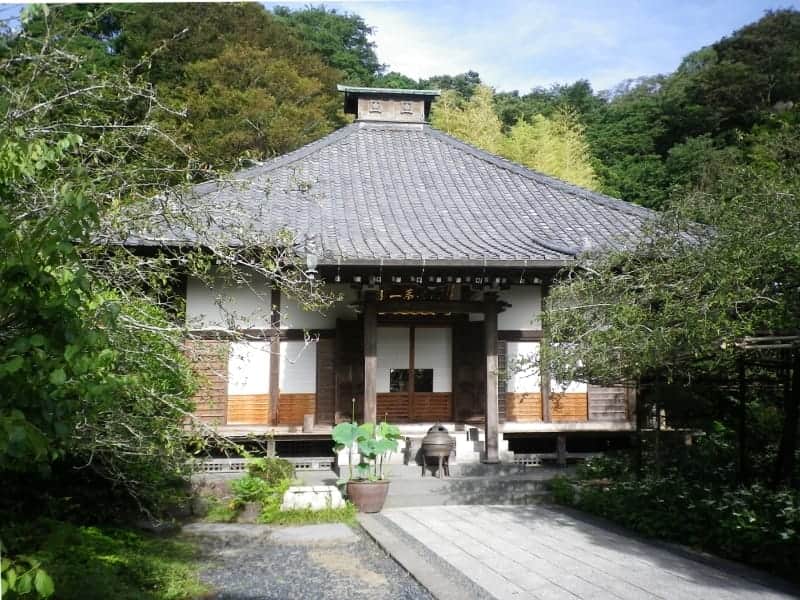
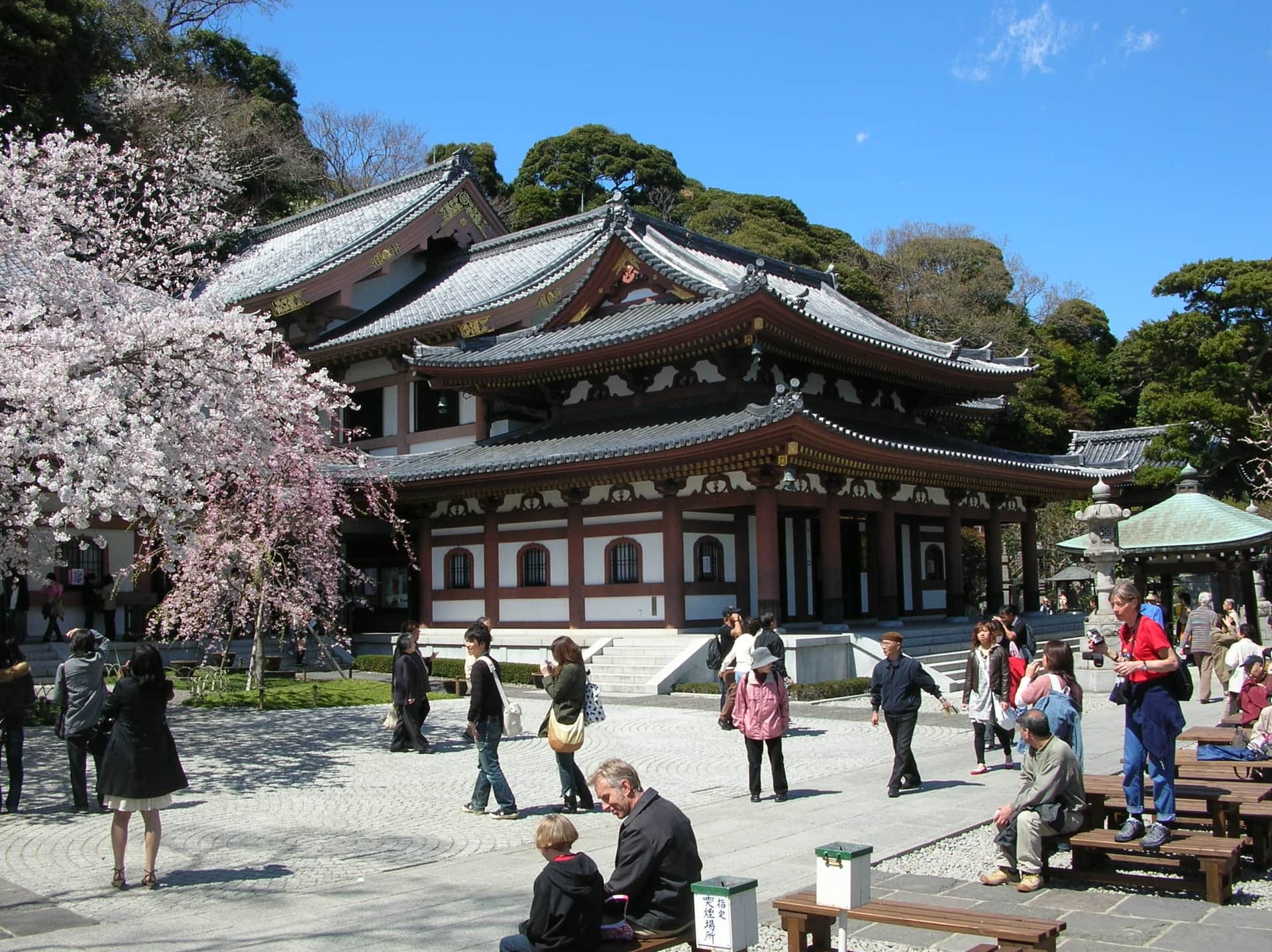
1 structures on the grounds
Typical Crowds
Lively
More ways to continue from this place.
Kamakura, Kanagawa Prefecture
What this place is believed to grant
Within 300 m Within 600 m Distance unavailable
Timetable data: Public Transportation Open Data Center
Renting needs the operator's app and a Japanese phone number. docomo day passes are sold at convenience stores. Data sources
22 recent posts
4.5
4 reviews
Arrive by train: the temple is a 7-minute walk from Hase Station on the Enoden line, which connects to JR Kamakura Station. There is no general parking, so plan on coming by rail or on foot. Early morning visits and autumn light both reward the effort, as cloud shadows move across the Buddha's face in ways that change the whole mood of the place.
The statue stands fully open to the sky year-round, so dress for the conditions. Summer calls for sun protection; winter means warm layers.
 MS
MSmassimo silvestrin left a review
Anna Rémond checked in
Kotoku-in
Kamakura, Kanagawa