The best views of the Golden Pavilion are from across the pond, where you can capture its reflection for the "inverted Kinkaku" effect.
At a Glance
Sunlight turns to liquid here. As the Golden Pavilion rises from its mirror of water, the upper stories—sheathed in 0.5 μm gold leaf—flare into brilliance, doubling themselves in the pond’s still surface so completely that the boundary between building and reflection seems to dissolve. This is Kinkaku-ji, the celebrated “Temple of the Golden Pavilion,” officially Rokuon-ji (“Deer Garden Temple”) in Kyoto—a Zen Buddhist sanctuary famed as a shariden (reliquary hall). Revered as part of the UNESCO-listed Historic Monuments of Ancient Kyoto, and protected both as a National Special Historic Site and a National Special Landscape, it stands today in the form rebuilt in 1955 after the pavilion’s tragic destruction by arson—a renewal that preserved its role and aura as a Zen reliquary at the heart of Rokuon-ji.
The story begins in the late 14th century, when the powerful shogun Ashikaga Yoshimitsu transformed a noble estate in Kyoto’s northern hills into his retirement villa, a dazzling expression of the Kitayama culture he championed. After Yoshimitsu’s death, the grounds were converted—per his wishes—into a Zen temple affiliated with the Rinzai school, adopting the formal name Rokuon-ji, derived from his posthumous title. The Golden Pavilion (Kinkaku) itself served as the estate’s spiritual core, a shariden designed to enshrine relics of the Buddha and to manifest the Buddhist Pure Land in living landscape.
The pavilion stood for centuries as an emblem of Muromachi aesthetics until 1950, when a devastating act of arson reduced it to ashes, searing itself into modern memory and inspiring wide literary reflection. In 1955, faithful to historical records and traditional craftsmanship, the pavilion was rebuilt, its purpose and silhouette restored. Later conservation campaigns enhanced durability and refreshed gilding, but the building’s role as a Zen reliquary and focal point of Rokuon-ji has remained constant. Throughout these transformations—medieval villa, Zen temple, catastrophe, and renewal—Kinkaku-ji has persisted as a touchstone of Japanese cultural identity.
At once austere and opulent, the Golden Pavilion concentrates a spectrum of Japanese architectural idioms into a three-story composition that floats above the Mirror Pond. The ground floor follows shinden-zukuri, the elegant residential style of the Heian court, expressed in open, airy spaces with white plaster walls and robust timber pillars. Above it, the second story embodies buke-zukuri, the samurai residential mode—more enclosed, disciplined, and formal. Crowning the composition, the top level adopts karayō (Zen/Chinese) stylistic cues, signaling the building’s religious vocation as a shariden.
Only the upper two floors carry the hallmark gold leaf—astonishingly thin at about 0.5 micrometers—applied over layers of lacquer to achieve a luminous, weather-defying skin that changes tone with light and season. The roof is a classic hip-and-gable (irimoya) form, topped by a gilded hōō (Chinese phoenix), a symbol of virtuous rule and auspicious rebirth. Together, these elements choreograph a visual ascent: from the earthly calm of natural wood, through the disciplined realm of warrior elegance, to the transcendent gleam of gilded sanctity.
As a reliquary hall, the pavilion’s interior historically housed sacred objects linked to the Buddha, with spaces proportioned for ritual and contemplation rather than congregation. Although visitors cannot enter, the building’s architecture reads clearly from the exterior—broad balconies, rhythmic railings, and measured overhangs—all reflect a grammar of balance that marries structural clarity to spiritual symbolism. The pavilion’s placement at the edge of water and its careful alignment to the garden compose an outdoor “theater of reflection,” in which the building, the pond, and the sky perform as one.
Kinkaku-ji’s religious identity is grounded in Rinzai Zen, yet its message resonates across Buddhist traditions. As a shariden, it serves as a material container for the immaterial—relics, memory, and the aspiration toward awakening. The gleam of the gold leaf is not merely display; in Buddhist iconography, gold signifies the purity of enlightenment, the radiance of wisdom that dispels delusion. The pavilion’s threefold stylistic hierarchy suggests a spiritual ascent from the worldly to the sublime, culminating in a sanctum that shelters the Buddha’s presence.
Beyond ritual function, Kinkaku-ji occupies a singular position in Japanese cultural consciousness. Its silhouette—gilded tiers rising above rippling water—has been endlessly reproduced in painting, woodblock prints, and modern media. The 1950 arson and the 1955 reconstruction entered national mythology, raising questions about impermanence and rebirth that echo Zen thought itself. Literary works, most famously a mid-20th-century novel inspired by the event, transformed the pavilion into a symbol through which modern Japan contemplated beauty, desire, and loss. That Kinkaku-ji endures as both sacred site and cultural icon speaks to its layered identity: a living temple, a museum of landscape, and a mirror for the nation’s imagination.
The temple’s garden is a masterwork of Muromachi landscape design, conceived as a chisen kaiyū-shiki (pond-centered strolling garden) in which architecture and nature form a single composition. The Mirror Pond (Kyōko-chi)—studded with islands and stone groupings—performs the magic on which the pavilion depends: reflective stillness. Pines lean toward the water with practiced elegance, moss banks soften stone, and the arrangement of shoreline and islets creates vistas that shift with each step, like panels in a handscroll painting.
Kinkaku-ji’s genius lies in “borrowed scenery” (shakkei): the low Kinugasa hills beyond the grounds appear to rise from within the garden, extending the temple’s realm without a fence or wall. In spring, azaleas and fresh maple leaves lend the gold a tender green glow; summer deepens the palette to lacquered emerald; autumn throws crimson maples against the pavilion’s warm sheen; and winter caps the roofline in snow, quieting the garden into monochrome serenity. Every season reinterprets the same forms, underscoring the core Buddhist insight that permanence and change are companions.
Approaching along the prescribed path, visitors first glimpse the Golden Pavilion obliquely across water—an intentional reveal that heightens wonder. The route then threads through viewpoint after viewpoint, each framing the building and garden in a new way: close reflections at the pond’s edge, angled perspectives through pines, and higher lookouts where the pavilion aligns with distant hills. While entry into the pavilion is restricted, the exterior vantage points are the intended experience, inviting slow looking rather than hurried checklist tourism.
Elsewhere on the grounds, auxiliary halls and a teahouse from later periods extend the story of patronage, ceremony, and tea culture that has long animated the site. Small sanctuaries and stone basins punctuate the path, reminding visitors that this remains a working Zen temple where rituals continue and caretakers maintain the cadence of monastic practice. Signage and site literature emphasize Kinkaku-ji’s recognition as part of the UNESCO-inscribed Historic Monuments of Ancient Kyoto, and its dual national protections—a National Special Historic Site and National Special Landscape—attest to both historical and scenic value preserved at the highest level.
Practical wisdom for the modern pilgrim mirrors the temple’s own design philosophy: arrive early or in late afternoon to catch the soft light that makes the gold leaf glow; move slowly; let reflections settle. Photography is permitted from designated spots, but the deepest impressions come from simply watching wind, cloud, and gilded wood stage their quiet dialogue. In this frame of mind, the pavilion’s 1955 rebirth reads less as replacement than as continuation—an acceptance, very Zen, that form must be renewed to safeguard spirit.
Kinkaku-ji ultimately offers two experiences at once. It is a precise historical artifact—its shariden function, Zen affiliation, and markers of status carefully documented—and it is a moving artwork of light and water that no document can fully capture. By setting the Golden Pavilion within a garden crafted to reflect and amplify its presence, Rokuon-ji renders philosophy visible: the world is a mirror, beauty is provisional, and what we cherish we must also maintain. To stand at the pond’s edge is to see architecture become atmosphere, a Kyoto icon composed of timber, lacquer, and a film of gold so thin—just 0.5 μm—that the sky itself seems to finish the job.
This temple offers 4 different goshuin designs
Same as opening hours
Regular
¥300
Regular
Regular
¥300
Regular
The best views of the Golden Pavilion are from across the pond, where you can capture its reflection for the "inverted Kinkaku" effect.
Explore the gardens: After the pavilion, follow the path through the 14th-century temple gardens, featuring Anmintaku Pond and Sekkatei Teahouse.
The temple offers beautiful views year-round, especially during autumn foliage and when blanketed in snow.
The best views and photos of the Golden Pavilion are from across Mirror Pond, where you can capture its reflection.
The divine spirits venerated at this sacred place
5 structures on the grounds
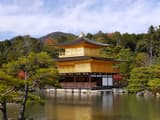
Three-story pavilion with top two floors completely covered in gold leaf, built overlooking a large pond. Each floor represents a different architectural style.
Tea house with titanium roof built in 2003, representing fusion of modern technology and traditional architecture
Also called Golden Pavilion
Kita, Kyoto Prefecture
Typical Crowds
Lively
Visit Duration
45-60 minutes
More ways to continue from this place.
What this place is believed to grant

Within 300 m Within 600 m Distance unavailable
22 recent posts
4.8
6 reviews
Arrive early to beat the crowds, as the site gets busy by mid-morning. The pavilion is stunning in autumn when the maples turn, and on rare snowy days the scene is especially striking.
The classic shot is from across Mirror Pond, where the reflection creates a near-perfect mirror image of the gilded structure. After taking that in, follow the garden path past Anmintaku Pond and the Sekkatei Teahouse, remnants of the 14th-century grounds that most visitors rush past.
 JM
JMJustine Muaux🐇💙🩵 left a review
Cadre serein. Simple et joli. Atmosphère paisible. Beau design de goshuin